Bible Study Thread: Luke

Welcome to Wondercafe2!

A community where we discuss, share, and have some fun together. Join today and become a part of it!

Status
Not open for further replies.
This is a wyrd statement.

Salt is NaCl. Does not get unsalty. And never good for either the soil or the compost.
One possibility I have heard or read is that often "salt" was not pure salt and sometimes it would get so adulterated that it no longer contained enough salt to do the job. At which point it was no longer of any use. (and for the record there are lots of other salts than NaCl, though many of them are not for consumption)
 
One possibility I have heard or read is that often "salt" was not pure salt and sometimes it would get so adulterated that it no longer contained enough salt to do the job. At which point it was no longer of any use.
This certainly sounds like a plausible explanation.

Salt was so valuable the unscrupulous might have mixed it with other substances.
 
Today, salt is very common and inexpensive. It is mostly used for melting ice. You can buy a lb of table salt for a buck. 40 lb of water softener salt for 7 ish.

Back in the day, salt was very valuable. Roman solidiers were sometimes paid in salt. He is worth his salt. If soldiers were paid in salt today, they would need trucks and pallets and lots of storage space. Very impractical form of money today.

Back in the day, with no refrigeration, salt was mainly a preservative. It kept things from going bad. So I think being salt of the earth and losing saltiness probably had more to do with keeping things from rotting than flavour.

The reference to soil and good fertilizer, maybe more to do with Jesus’ other parable about the types of soil that people who hear the good news find themselves in.
 
The reference to soil and good fertilizer, maybe more to do with Jesus’ other parable about the types of soil that people who hear the good news find themselves in.
Could be. How would you interpret the reference to salt in today's text, then? What is Jesus getting at here?
 
paradox3 ---it is not a game paradox3 --it is understanding what the text is really saying -----but I guess your not interested in knowing by your comment to me --so keep your common meaning -----out of the heart the mouth speaks ------


Todays scripture ----

14:25-35(NKJV)
Leaving All to Follow Christ
25 Now great multitudes went with Him. And He turned and said to them, 26 “If anyone comes to Me and does not hate his father and mother, wife and children, brothers and sisters, yes, and his own life also, he cannot be My disciple. 27 And whoever does not bear his cross and come after Me cannot be My disciple. 28 Forwhich of you, intending to build a tower, does not sit down first and count the cost, whether he has enough to finish it— 29 lest, after he has laid the foundation, and is not able to finish, all who see it begin to mock him, 30 saying, ‘This man began to build and was not able to finish’? 31 Or what king, going to make war against another king, does not sit down first and consider whether he is able with ten thousand to meet him who comes against him with twenty thousand? 32 Or else, while the other is still a great way off, he sends a delegation and asks conditions of peace. 33 So likewise, whoever of you does not forsake all that he has cannot be My disciple.


unsafe says ----Jesus spells out who can be His Disciple and who can't -------

The First Commandment needs to be adhered to ----God must be first in our priorities not anyone else -----Our Love for God and Following Him must come first ----anyone who does not put God first in their priorities will not and cannot be His Disciple -----

Anyone who cannot bear his cross also cannot be His Disciple ------

unsafe says -----The cross does not come cheap for us to bear as True Christians ----- it is withstanding persecution by calling on Grace so that when the True Christian feel the persecution of the ungodly they are able to hold true to God and His word ------ not matter what may come against them -----this takes Thick skin and Maturing in Christ --It is laying self down and putting all worldly desires away and Relying on God to supply what we need and relying on God's Grace to give us strength in our weakest times To stay out of sin -----


Verses 28-33 is all about measuring the cost of following Jesus and see if you can truly be a follower ---Is it possible to be a follower of Christ without waging the Cost ???

The Tower here was a building of protection so if one does not count the cost of having enough materials to finish the job could be mocked by his friends and be humiliated ----Or like a King going to war and doesn't count the cost of how many men he needs to defeat his enemy -----


unsafe says ----Seems counting the cost of being a True Disciple of Christ is important before we say we are a follower Christ ----


Verses 34-35 ------
Tasteless Salt Is Worthless
34 “Salt is good; but if the salt has lost its flavor, how shall it be seasoned? 35 It is neither fit for the land nor for the [a]dunghill, but men throw it out. He who has ears to hear, let him hear!”


unsafe says ----Salt is a preservative-----so the context of todays scripture is all about the Cost of Discipleship ------so Salt here is used in this context of what the scripture is about ------God's Preserving and Seasoning True Believers --Disciples as they grow in loving God with all their heart --soul mind and strength and in all relationships they build --If a true Disciple loses His saltiness then what good is he to God -------

True Disciples are the Salt of the Earth

Image result for true disciples are the salt of the earth
 
This is just a bad analogy. Salt (and yes, I was referring to "table salt, sodium chloride", as I assumed were the scripture writers) stays salt. It never 'becomes' another compound that doesn't taste salty to the human tongue.

The text doesn't suggest that the salt gets adulterated. It suggests that it gets not salty, and that isn't possible.

So as analogy, it doesn't work. If salt can't actually lose it's saltiness , neither can a Disciple lose their value to God?
 
The text doesn't suggest that the salt gets adulterated. It suggests that it gets not salty, and that isn't possible.

Given a lack of the understanding of chemistry that we possess, thinking that adulterated salt has become "less salty" would actually be quite reasonable and might be how they would approach it rather than thinking it was "adulterated". I wouldn't be so quick to dismiss that analogy, IOW.
 
True Disciples are the Salt of the Earth
What do you think is meant by "the salt of the earth"? This phrase appears in Matthew's gospel but not in Luke or Mark.

It is kind of interesting to compare the three parallel texts. The salt losing its saltiness seems to be the commonality:

Luke 14:34-35 New Revised Standard Version (NRSV)
About Salt
34 “Salt is good; but if salt has lost its taste, how can its saltiness be restored?[a] 35 It is fit neither for the soil nor for the manure pile; they throw it away. Let anyone with ears to hear listen!”

Matthew 5:13 New Revised Standard Version (NRSV)
Salt and Light
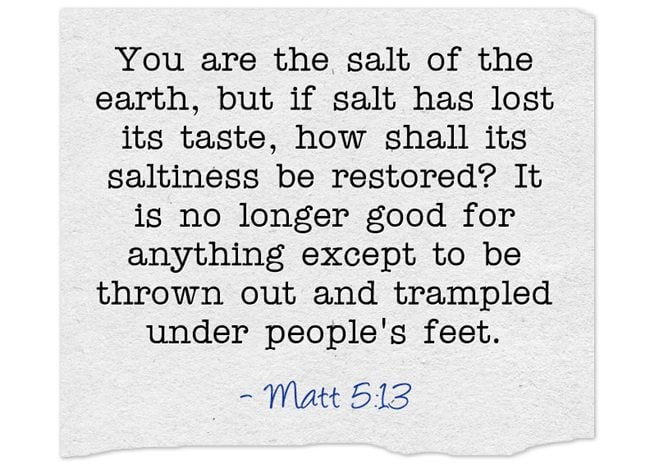
13 “You are the salt of the earth; but if salt has lost its taste, how can its saltiness be restored? It is no longer good for anything, but is thrown out and trampled under foot.

Mark 9:49-50 New Revised Standard Version (NRSV)
49 “For everyone will be salted with fire.[a] 50 Salt is good; but if salt has lost its saltiness, how can you season it?[b] Have salt in yourselves, and be at peace with one another.”
 
I think that's a potential misreading, though. If you read it as "salt of the Earth" (ie. capitalize it to make it refer to the planet, not the ground) then it could be interpreted as being that which gives flavour to the world, just as salt gives flavour to food.
 
I know we use this phrase, but salt poisons the earth. This further confuses all of these sayings.
But salt also comes from the earth. Apparently we have the largest salt mine in the world here in Goderich, Ontario. I don't know anything about the history of salt mining but "salt mine" is a euphemism for extremely hard labor.

In biblical times, salt was probably processed from the Dead Sea and other places. It still would have been very labor intensive, I imagine, making salt very valuable.

Yes, these are puzzling sayings.
 
I think that's a potential misreading, though. If you read it as "salt of the Earth" (ie. capitalize it to make it refer to the planet, not the ground) then it could be interpreted as being that which gives flavour to the world, just as salt gives flavour to food.
Yes, big difference between earth and Earth.

The saying could also mean preserving and/ or purifying the world (two other properties of salt).
 
I think that's a potential misreading, though. If you read it as "salt of the Earth" (ie. capitalize it to make it refer to the planet, not the ground) then it could be interpreted as being that which gives flavour to the world, just as salt gives flavour to food.

Or that which preserves the world, just as salt preserves food.
 
Summary : Luke 15: 1 - 10

The Pharisees and scribes are grumbling that Jesus welcomes tax collectors & sinners and eats with them. So Jesus tells two parables.

1. Which of you, having one hundred sheep and losing one of them, would not go looking for it? He will leave the 99 in the wilderness and go after the one that is lost until he finds it. When the sheep is found, he lays it on his shoulders and rejoices. Neighbors and friends are called together to rejoice.

There will be more joy in heaven over one sinner who repents than over 99 righteous persons who need no repentance.

2. What woman, having ten silver coins, does not light a lamp, sweep the house and search carefully until she finds it? When she finds the coin, she calls together her friends and neighbors to rejoice with her.

There is joy in the presence of the angels of God over one sinner who repents.
 
Reflection: Luke 15: 1 - 10

Here are two little parables I remember from my Sunday School days. They serve as an introduction to the much longer Parable of the Prodigal and His Brother.

In both stories, something valuable has been lost. The owner searches for what has been lost and rejoices when it is found. Friends and neighbors are brought together to celebrate.

There will be joy in heaven when one sinner repents. More rejoicing than there will be over ninety-nine righteous who need no repentance.

What do you think is meant by repentance in these parables told by Jesus? Jesus frequently calls us to repentance in the gospels. Does he mean contrition? Confession? Making amends with those we have hurt in any way? Turning away from a sinful lifestyle? All of the above?

The message seems to be that God will welcome us and rejoice if we repent. How do we understand repentance?

It seems that there are some of the righteous who have no need for repentance.
 
What do you think is meant by repentance in these parables told by Jesus? Jesus frequently calls us to repentance in the gospels. Does he mean contrition? Confession? Making amends with those we have hurt in any way? Turning away from a sinful lifestyle? All of the above?

The message seems to be that God will welcome us and rejoice if we repent. How do we understand repentance?
These are good questions - and I'm uncertain of the answers. I'm hoping some of our reverends and scholars will aid in understanding what this meant in the time that it was preached and how they interpret that today.
 
Repentance in the Spiritual is a ----Mind change ---it involves Sinful behaviours ----you can't change your behaviour till you change the way you think -------because first of all you have to know the 2 sides of the coin on the way to think -----their is worldly thinking and then their is the Spiritual side of thinking -----and until you know what the Spiritual side says about the way we are to think and act ---you only know the one way which is the world's way ------and one has to have their heart open to embrace that change ------

Changing the way a person thinks take hard work and discipline and staying the course and most humans don't have the stamina to stay the course to change their thinking to the Spiritual way -----and many just don't want to change the wat they think cause they see nothing wrong with their thinking ------

True Repentance is a total change both in their thinking and behaviour -------everything we do starts with a thought -----only then do we act -----changing the way of thinking is the only way to true repentance


Greek for Repent

Strong's Concordance
metanoeó: to change one's mind or purpose
Original Word: μετανοέω
Part of Speech: Verb
Transliteration: metanoeó
Phonetic Spelling: (met-an-o-eh'-o)
Definition: to change one's mind or purpose
Usage: I repent, change my mind, change the inner man (particularly with reference to acceptance of the will of God), repent.

3340
metanoéō (from 3326 /metá, "changed after being with" and 3539 /noiéō, "think") – properly, "think differently after," "after a change of mind"; to repent (literally, "think differently afterwards")


Romans 8:5-21 (AMP)

5 For those who are living according to the flesh set their minds on the things of the flesh [which gratify the body], but those who are living according to the Spirit, [set their minds on] the things of the Spirit [His will and purpose].

6 Now the mind of the flesh is death [both now and forever—because it pursues sin]; but the mind of the Spirit is life and peace [the spiritual well-being that comes from walking with God—both now and forever]; 7 the mind of the flesh [with its sinful pursuits] is actively hostile to God. It does not submit itself to God’s law, since it cannot, 8 and those who are in the flesh [living a life that caters to sinful appetites and impulses] cannot please God.
 
Todays Scripture

Luke 15:1-10 GW

The Lost Sheep
15 All the tax collectors and sinners came to listen to Jesus. 2 But the Pharisees and the experts in Moses’ Teachings complained, “This man welcomes sinners and eats with them.”

3 Jesus spoke to them using this illustration: 4 “Suppose a man has 100 sheep and loses one of them. Doesn’t he leave the 99 sheep grazing in the pasture and look for the lost sheep until he finds it? 5 When he finds it, he’s happy. He puts that sheep on his shoulders and 6 goes home. Then he calls his friends and neighbors together and says to them, ‘Let’s celebrate! I’ve found my lost sheep!’ 7 I can guarantee that there will be more happiness in heaven over one person who turns to God and changes the way he thinks and acts than over 99 people who already have turned to God and have his approval.”

The Lost Coin
8 “Suppose a woman has ten coins and loses one. Doesn’t she light a lamp, sweep the house, and look for the coin carefully until she finds it? 9 When she finds it, she calls her friends and neighbors together and says, ‘Let’s celebrate! I’ve found the coin that I lost.’ 10 So I can guarantee that God’s angels are happy about one person who turns to God and changes the way he thinks and acts.”


unsafe says -----We see the Pharisees at Jesus again for sitting with sinners -----and Jesus tells then a Parable about The Lost Sheep -----Sinners are the Lost Sheep and Jesus is the Good Shepard who goes Looking for His lost sheep --sin separates man from God and exposes these people to eternal ruin ---Jesus works in earnest to bring the lost sheep back into the fold ------

The parable of the lost coin we see the woman doing everything she can to try and find the coin -----this shows us the various means and methods that God uses to try and bring the lost souls home to Him and what joy God has when He is successful in this endeavor ----our repentance should be unto Salvation ------


Related image
 
Reflection: Luke 15: 1 - 10

Here are two little parables I remember from my Sunday School days. They serve as an introduction to the much longer Parable of the Prodigal and His Brother.

In both stories, something valuable has been lost. The owner searches for what has been lost and rejoices when it is found. Friends and neighbors are brought together to celebrate.

There will be joy in heaven when one sinner repents. More rejoicing than there will be over ninety-nine righteous who need no repentance.

What do you think is meant by repentance in these parables told by Jesus? Jesus frequently calls us to repentance in the gospels. Does he mean contrition? Confession? Making amends with those we have hurt in any way? Turning away from a sinful lifestyle? All of the above?

The message seems to be that God will welcome us and rejoice if we repent. How do we understand repentance?

It seems that there are some of the righteous who have no need for repentance.
The interesting thing about the three parables that make up Luke 15 is that while there is mention in the first two of repentance all three are about the lost ones who are searched for, the Sheep and the Coin are not able to do anything to repent. The Youngest Son has a whole speech lined up but it is not required (the eldest son is also lost in that arable but we can talk about that later since @paradox3 has separated the three parables in a way many others do but I prefer to keep them as a unit).

SO yeah it says God rejoices when one repents. But the stories suggest a God (if one assumes that God is the shepherd, the woman and the father -- common interpretations but maybe not the only ones since parables are not analogies?) who searches and searches and welcomes with or without repentance.
 
Which would be a totally dishonest interpretation.

I interpret what you said above to mean that you hate paradox3 because of the way she is running this study. Your way is the ONLY way.
 
Status
Not open for further replies.
Back
Top