Wondercafe2 ... in SPAAAAAAACE!

Welcome to Wondercafe2!

A community where we discuss, share, and have some fun together. Join today and become a part of it!

Exactly. Viruses are designed by evolution to require quite specific hosts to succeed in getting copied. Very unlikely a suitable host would exist on Mars for any viruses from Earth
 
Exactly. Viruses are designed by evolution to require quite specific hosts to succeed in getting copied. Very unlikely a suitable host would exist on Mars for any viruses from Earth
If there are terrestrial viruses reaching Mars then technically suitable hosts, including terrestrial bacteria, are too.
 
Thus we bac ilitate ... as something from il-ite .... "-ite" meaning alloyed at one time ... perhaps by some iron!

Iron bacteria can be nasty ...
 
Bacteria have four sources of food energy. Living hosts, organic matter, iron, and light. The first two seem to be missing on Mars. Iron bacteria generally need water, carbon dioxide, and oxygen. I suspect there are not many bacteriophages that attack iron bacteria. Photosynthesizing bacteria will need water, carbon dioxide, nitrogen, and some other minerals. I suspect they also have very few bacteriophages. Viruses generally need millions of copies to succeed at infecting one suitable larger host and probably dozens to hundreds of copies to succeed as bacteriophages. I would put the odds of viruses or bacteria surviving very long on Mars except as spores in the case of bacteria. UV light is very hard on viruses and the Martian atmosphere does not provide much protection from UV. Humans would only need to worry about the viruses that are traveling with them.
 
Last edited:
Bacteria have four sources of food energy. Living hosts, organic matter, iron, and light. The first two seem to be missing on Mars. Iron bacteria generally need water, carbon dioxide, and oxygen. I suspect there are not many bacteriophages that attack iron bacteria. Photosynthesizing bacteria will need water, carbon dioxide, nitrogen, and some other minerals. I suspect they also have very few bacteriophages. Viruses generally need millions of copies to succeed at infecting one suitable larger host and probably dozens to hundreds of copies to succeed as bacteriophages. I would put the odds of viruses or bacteria surviving very long on Mars except as spores in the case of bacteria. UV light is very hard on viruses and the Martian atmosphere does not provide much protection from UV. Humans would only need to worry about the viruses that are traveling with them.
I think the jury is still out on life on Mars and may not be settled until the samples being collected by Perseverance get collected and brought back. I hope that happens before any humans go, not because I am worried about their effect on the humans but about the humans' effect on the bacteria. If we introduce a bacteriophagous virus into that ecosystem, it is probably screwed. If we mess with the environment on Mars, including attempting terraforming, it is probably screwed. I am opposed to colonizing or even visiting Mars until we know if there is a native ecosystem, not because I am worried about us, but because I am worried about them. And if that means we are stuck on a dying Earth, so be it. Better we go extinct than destroy yet another ecosystem.

Bacteria do not need living hosts like viruses do. There are free swimming bacteria that live in just about every environment on Earth. Only the ones that have evolved to live in a living being need a host.
 
Bacteria have four sources of food energy. Living hosts, organic matter, iron, and light. The first two seem to be missing on Mars. Iron bacteria generally need water, carbon dioxide, and oxygen. I suspect there are not many bacteriophages that attack iron bacteria. Photosynthesizing bacteria will need water, carbon dioxide, nitrogen, and some other minerals. I suspect they also have very few bacteriophages. Viruses generally need millions of copies to succeed at infecting one suitable larger host and probably dozens to hundreds of copies to succeed as bacteriophages. I would put the odds of viruses or bacteria surviving very long on Mars except as spores in the case of bacteria. UV light is very hard on viruses and the Martian atmosphere does not provide much protection from UV. Humans would only need to worry about the viruses that are traveling with them.

Imagine such carriers as an enemy within ... few understand the idea of life finding difficulty in the presence of Dark Light (UV)) ... thus no light beyond the UV ul as in that Batman image in the Skye 've Nacht ... knackery!
 
Bacteria and fungi from earth are the biggest threat to any life that might be on Mars.
Why the great mystery produced Earth in Ur great autonomy! She may be venerable or a veneer inclined to vicious dis ease ...

All in all much is in dis array and disorder ... just to support ... frustration of mother nature ... Maan loves to agitate Hur ... with things that cause her to lose common sentient matter ...

In such order chez gives birth to naivete ... isn't that an ignorant objective? (also poorly understood word)
 
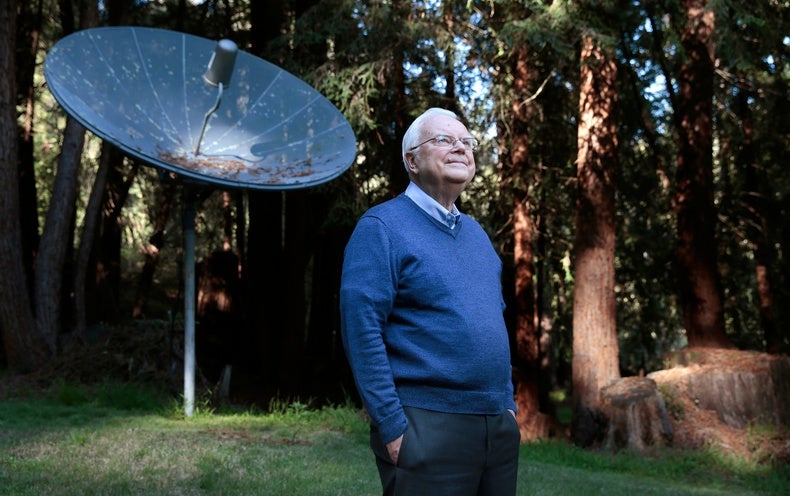
I kind of missed this story until I got this week's Space & Physics newsletter from Scientific American. Frank Drake was a major figure in astronomy who is best know for pioneering early efforts at trying to find and communicate with civilizations in other star systems. His Project SETI became the blueprint for subsequent searches of the sky for radio signals from other societies. And his famed "Drake's Equation" used a number of factors to try to calculate the probability of finding other civilizations. While at one time, many of the factors in it, such as a how many stars had planets, were just dartboard guesses, we have now filled in several of them with some degree of accuracy as we discover and learn more about exo-planets and other solar systems. Frank passed away a week ago at 92.

 
Aaand one of my fav Hopepunk authors Andy Weir (The Martian, Project Hail Mary) also wrote Artemis, which I finished listening to. You might enjoy :3

Also recall Northwind's delightful Artemis :3
 
NASA threw a DART at an asteroid. And scored a bullseye, it seems. The DART mission is the first test of whether we could divert an asteroid on a collision course with Earth by crashing a spacecraft into it. Under Newton's laws of motion, hitting the asteroid with enough force in the right spot should change its course. But would it change it enough?

For this test, they chose an asteroid that is not a risk. In fact, it is a tiny asteroid that is orbiting a larger one. By crashing DART into it and then making observations of how the collision affects its orbit around the larger asteroid, NASA hopes to be able to get some actual experimental data on this method of diverting a potentially devestating asteroid.

Here is the story from CNN with NASA's footage of the approach.


And NASA TV's full coverage

 
NASA threw a DART at an asteroid. And scored a bullseye, it seems. The DART mission is the first test of whether we could divert an asteroid on a collision course with Earth by crashing a spacecraft into it. Under Newton's laws of motion, hitting the asteroid with enough force in the right spot should change its course. But would it change it enough?

For this test, they chose an asteroid that is not a risk. In fact, it is a tiny asteroid that is orbiting a larger one. By crashing DART into it and then making observations of how the collision affects its orbit around the larger asteroid, NASA hopes to be able to get some actual experimental data on this method of diverting a potentially devestating asteroid.

Here is the story from CNN with NASA's footage of the approach.


And NASA TV's full coverage

I didnt watch the videos yet, so maybe they mentioned this....apparently they wont know for a couple weeks if the direction was changed.
 
An asteroid is just an Ork, or Ort ... shard of the beginning thing out there ... fallout of fallacy?

When you look at what desire has done ... perhaps one can understand how it all went down ... tremendous baggage in that vast empty sea ... Ci? Something meant to stare into ... don't go there ... you don't know what'll tumble out ... some crosses by others reflect!

Thoughts are difficult even complex ... not to be simplified ... or they become a line like some brute leaders ...

Imagine supporting the naïve ... that's innocent? Shouldn't they have learned pragmatically about doing yourself? That's autonomous ... independent pas Zions ... unshared ... out of season? There is a time ... for all things ...

If one screws up in public is i critical that the knowledge spreads? Just for har Deis humor ... and where the laughter is source de ire! That's reflection ... it can really disturb the sacred waters ... tis a mort thing ... it'll come round!

Gets OHM ...
 
Last edited:
And it appears that NASA's proof of concept proved its concept. They appear to have knocked 32 min (+/- 2 min) off the orbit of Dimorphos (the smaller asteroid) around Didymos (the larger). Of course, to change the course of a large asteroid that could be a serious threat would require a much bigger impactor, but at least we know that in principle, it could work.

 
Back
Top
