There is no “both sides can be accused...” when we’re dealing with the rise of neo-Nazis. Just nope. Sorry. No.I do recognize the right appears to be wanting to limit free speech using different methods. In a polarized society, both sides can be accused of this.


Navigation
Install the app
How to install the app on iOS
Follow along with the video below to see how to install our site as a web app on your home screen.
Note: This feature may not be available in some browsers.
More options
You are using an out of date browser. It may not display this or other websites correctly.
You should upgrade or use an alternative browser.
You should upgrade or use an alternative browser.
TRUMP - Some people think......... How do you feel?
- Thread starter crazyheart
- Start date
More options
Who Replied?That both sides have equally valid and true things to say, and that therefore there is a valid middle ground in every instance, is a logical fallacy.
 en.m.wikipedia.org
Argument to moderation - Wikipedia
What “good” is right wing politics bringing to the table today - answer me that? What is so good about it when it gives voice to neonazis?

GeoFee
I am who I am becoming...
On both (all) sides there are persons seeking the common good and persons serving private interest. This is my criteria of distinction, with my preference being for those seeking the common good. My hope is that private interest will be erased from human history. I am quite sure this hope will not be obtained by politics.
I’m in the middle of the left side. I don’t see the left as being as radically emotional as the right...when they are emotional it’s in expressing a yearning for equality. That’s not radical. That’s human and normal.
Last edited:
Who is seeking common good on the right if they don’t flat out denounce Trump?On both (all) sides there are persons seeking the common good and persons serving private interest. This is my criteria of distinction, with my preference being for those seeking the common good. My hope is that private interest will be erased from human history. I am quite sure this hope will not be obtained by politics.
You can’t avoid politics. It’s political to be human. It’s human to be political. You are usually political. It’s part of the mix of being human.On both (all) sides there are persons seeking the common good and persons serving private interest. This is my criteria of distinction, with my preference being for those seeking the common good. My hope is that private interest will be erased from human history. I am quite sure this hope will not be obtained by politics.
The “both sides” argument is fallacious. Both sides are not equally valid when it comes to creationism vs. evolution, for example. Both sides are not equally valid on climate change. Both sides are also not equally valid in their argument for free speech. The right is abusing free speech and manipulating its intent with its crusade for supposedly free speech by using it to further an agenda of harm to marginalized groups. There is no middle ground between some positions.
GeoFee
I am who I am becoming...
I act symbolically in the public square but have no confidence or investment in political means. In Fredericton I was asked to stand for election by the Federal NDP. I agreed to consider this possibility. My participation in process with party representatives persuaded me to appreciate but decline the offer of candidacy. It became clear at the outset that prevailing strategies would require compromise of my ethical priorities. Which I am unable to do by virtue of my ancestry and heritage.You are usually political.
You do what you can inside the democratic process. I'll do what I can from the outside. I trust we share insight and effort directed to the healing of our human nature, and determination to establish and perpetuate the common good.

Ritafee
Is Being Human
The dominant religion of 'America' is politics - I will give you that.You can’t avoid politics. It’s political to be human. It’s human to be political. You are usually political. It’s part of the mix of being human.
I think it's cultural.The dominant religion of 'America' is politics - I will give you that.
But I am watching The movie Family... US politics is also dominated by the religious right. They don't want anyone else to be represented. Also, most republican voters are white (edit: 83%) When you mix the two you get authoritarian and religiously motivated white nationalism...at least there's not a lot of space between the two. So, to me, that delegitimizes right wing politics while the left represents a broader diversity of voices, in particular, marginalized voices.
Last edited:
Ritafee
Is Being Human
Calling for a “political revolution,” career politician Sanders has argued that “no matter who is elected to be president, that person will not be able to address the enormous problems facing the working families of our country.” Instead, grassroots movements are needed to change the focus on the national discussion.
In Birmingham, Alabama, in the spring of 1963 King, his advisors and local activists set out to consciously engineer a nonviolent uprising that could “create such a crisis and establish such creative tension” that the injustice of segregation would be forced onto the national stage. Their success changed King’s vision of what could be accomplished outside the limits of formal politics.
A traditional view of power gives credit for social change to the political leaders who pass landmark legislation. This perspective sees the Civil Rights Act of 1964 as foremost the result of the legendary arm-twisting of President Lyndon Johnson. During her 2008 campaign Clinton herself embraced this view, emphasizing Johnson’s role. In this case, it created a scandal for her, as defenders of the civil rights movement charged Clinton with advancing a blinkered view of history.
In fact, mass noncompliance in Birmingham and beyond convinced politicians who would have preferred to drag their feet that inaction was no longer a viable option. As historian Adam Fairclough writes, it convinced Attorney General Robert Kennedy that “the federal government, unless it adopted a more radical policy, would be overwhelmed.”
Fairclough further adds, “Birmingham, and the protests that immediately followed it, transformed the political climate so that civil rights legislation became feasible; before, it had been impossible.”
Through the end of his life, King remained committed to using social movement pressure to force officials to act in ways they would have otherwise avoided.
In Birmingham, Alabama, in the spring of 1963 King, his advisors and local activists set out to consciously engineer a nonviolent uprising that could “create such a crisis and establish such creative tension” that the injustice of segregation would be forced onto the national stage. Their success changed King’s vision of what could be accomplished outside the limits of formal politics.
A traditional view of power gives credit for social change to the political leaders who pass landmark legislation. This perspective sees the Civil Rights Act of 1964 as foremost the result of the legendary arm-twisting of President Lyndon Johnson. During her 2008 campaign Clinton herself embraced this view, emphasizing Johnson’s role. In this case, it created a scandal for her, as defenders of the civil rights movement charged Clinton with advancing a blinkered view of history.
In fact, mass noncompliance in Birmingham and beyond convinced politicians who would have preferred to drag their feet that inaction was no longer a viable option. As historian Adam Fairclough writes, it convinced Attorney General Robert Kennedy that “the federal government, unless it adopted a more radical policy, would be overwhelmed.”
Fairclough further adds, “Birmingham, and the protests that immediately followed it, transformed the political climate so that civil rights legislation became feasible; before, it had been impossible.”
King remained committed to using social movement pressure to force officials to act in ways they would have otherwise avoided.
Seeking to quell speculation about a King/Spock ticket, King called a meeting with reporters in April 1967 and announced that he was not interested in running. “I have come to think of my role as one which operates outside the realm of partisan politics,” King said.
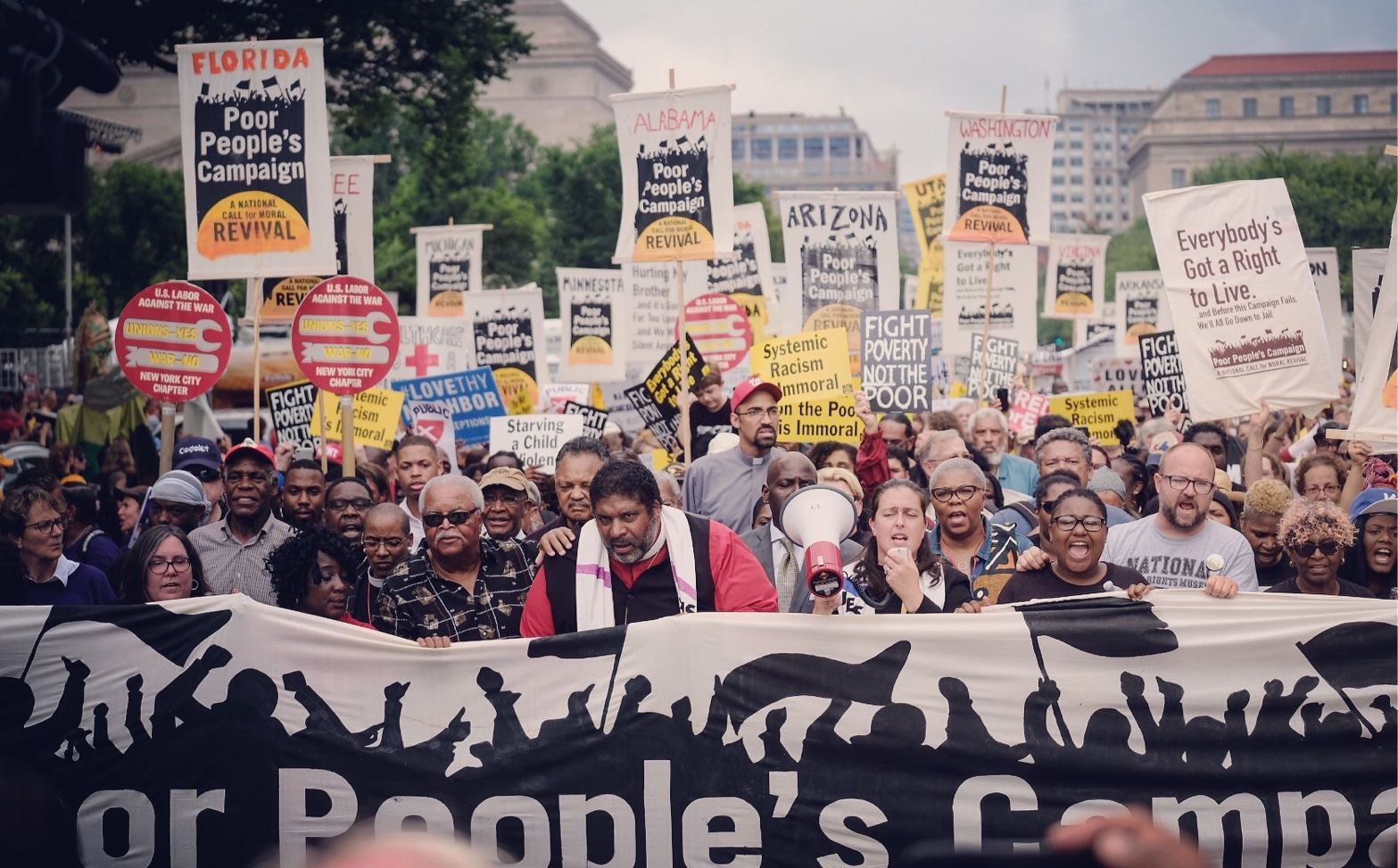
Opting against a presidential run, he instead launched the “Poor People’s Campaign,” which proposed a major wave of disruptive protest in Washington, D.C., designed to compel action around economic inequality. “We believe that if this campaign succeeds, nonviolence will once again be the dominant instrument for social change — and jobs and income will be put in the hands of the tormented poor,” King stated in 1968.
Politically, an assassin’s bullet prevented him from bringing the mobilization to fruition.
 www.poorpeoplescampaign.org
In Birmingham, Alabama, in the spring of 1963 King, his advisors and local activists set out to consciously engineer a nonviolent uprising that could “create such a crisis and establish such creative tension” that the injustice of segregation would be forced onto the national stage. Their success changed King’s vision of what could be accomplished outside the limits of formal politics.
A traditional view of power gives credit for social change to the political leaders who pass landmark legislation. This perspective sees the Civil Rights Act of 1964 as foremost the result of the legendary arm-twisting of President Lyndon Johnson. During her 2008 campaign Clinton herself embraced this view, emphasizing Johnson’s role. In this case, it created a scandal for her, as defenders of the civil rights movement charged Clinton with advancing a blinkered view of history.
In fact, mass noncompliance in Birmingham and beyond convinced politicians who would have preferred to drag their feet that inaction was no longer a viable option. As historian Adam Fairclough writes, it convinced Attorney General Robert Kennedy that “the federal government, unless it adopted a more radical policy, would be overwhelmed.”
Fairclough further adds, “Birmingham, and the protests that immediately followed it, transformed the political climate so that civil rights legislation became feasible; before, it had been impossible.”
Through the end of his life, King remained committed to using social movement pressure to force officials to act in ways they would have otherwise avoided.
In Birmingham, Alabama, in the spring of 1963 King, his advisors and local activists set out to consciously engineer a nonviolent uprising that could “create such a crisis and establish such creative tension” that the injustice of segregation would be forced onto the national stage. Their success changed King’s vision of what could be accomplished outside the limits of formal politics.
A traditional view of power gives credit for social change to the political leaders who pass landmark legislation. This perspective sees the Civil Rights Act of 1964 as foremost the result of the legendary arm-twisting of President Lyndon Johnson. During her 2008 campaign Clinton herself embraced this view, emphasizing Johnson’s role. In this case, it created a scandal for her, as defenders of the civil rights movement charged Clinton with advancing a blinkered view of history.
In fact, mass noncompliance in Birmingham and beyond convinced politicians who would have preferred to drag their feet that inaction was no longer a viable option. As historian Adam Fairclough writes, it convinced Attorney General Robert Kennedy that “the federal government, unless it adopted a more radical policy, would be overwhelmed.”
Fairclough further adds, “Birmingham, and the protests that immediately followed it, transformed the political climate so that civil rights legislation became feasible; before, it had been impossible.”
King remained committed to using social movement pressure to force officials to act in ways they would have otherwise avoided.
Seeking to quell speculation about a King/Spock ticket, King called a meeting with reporters in April 1967 and announced that he was not interested in running. “I have come to think of my role as one which operates outside the realm of partisan politics,” King said.
Opting against a presidential run, he instead launched the “Poor People’s Campaign,” which proposed a major wave of disruptive protest in Washington, D.C., designed to compel action around economic inequality. “We believe that if this campaign succeeds, nonviolence will once again be the dominant instrument for social change — and jobs and income will be put in the hands of the tormented poor,” King stated in 1968.
Politically, an assassin’s bullet prevented him from bringing the mobilization to fruition.
Our Demands - Poor People's Campaign
Click Here to View Our Policy Platform A Moral Agenda Based on Fundamental Rights Over the past few years, the Poor People’s Campaign: A National Call for Moral Revival has connected with communities across this nation to learn from the struggles being waged. We have met with tens of thousands...
www.poorpeoplescampaign.org
Last edited:
King was definitely political. He was considered radical then, and there was no compromise he should've made with regard to anti-segregation. There was no valid "both sides". ...there's no way he would've respected the goals of the Republican Party or the religious right today. He would engage in non-violent disagreement and dissent but he would not support their goals. He was much like Cornel West, today (Cornel West is like him, rather).
Ritafee
Is Being Human
There was no valid "both sides". ...there's no way he would've respected the goals of the Republican Party or the religious right today. He would engage in non-violent disagreement and dissent but he would not support their goals. He was much like Cornel West, today (Cornel West is like him, rather).
"Sixty cents of every $1 of U.S. budget goes to the military-industrial complex, Trump’s $750 billion military budget. Who voted for that? Democrats as well as Republicans. That’s part of the imperial extension, that makes it difficult for us to speak to issues of healthcare, jobs with a living wage. It suffocates the domestic agenda. And Martin Luther King Jr., our dear Sister Dolores and Cesar Chavez and others, those grand exemplars of the social movements of the past, they understood that. And I think that’s part of the challenge that we have to bring." - West
I think there’s been a shift leftward for the Democrats. I agree the typical establishment Dems were not as far apart in policy from the right as they’d have people believe. But they are diverse enough to have space for non-white, non-Christian women to have a voice in Congress. The same is not true of Republicans.
