Revisiting Mark

Welcome to Wondercafe2!

A community where we discuss, share, and have some fun together. Join today and become a part of it!

Status
Not open for further replies.
The woman who touches the cloak worn by Jesus is healed by her faith alone. Jesus doesn't do anything active to heal her and he actually feels the "power go out of him" when she touches him.

She had been bleeding for 12 years and would have been considered unclean...so that was a risky move on her part in more ways than one. Jesus acknowledging her faith and not condemning her, probably also demonstrated some social restorative justice .....well at least that's the way I want to see it. :giggle:
 
Redbaron -----I say -----you are so right it is a division of the Roman army a large number of them usually of 6.ooo in a legion

I say ----So you can imagine the strength of these league of demons and the scripture reflects this -----

3 This man lived in the tombs, and no one could bind him anymore, not even with a chain. 4 For he had often been chained hand and foot, but he tore the chains apart and broke the irons on his feet. No one was strong enough to subdue him. 5 Night and day among the tombs and in the hills he would cry out and cut himself with stones.
 
We haven't really talked about Jairus' daughter. Is it a healing? A resurrection? Is she dead or in a coma (which could be taken for death in pre-modern societies)? There's a fairly obvious lesson about faith in the woman touching his robe and about Jesus power over spirits in the Gerasene demoniac, but what is the lesson here? If one takes it as a resurrection, then it could presage things to come. But if she was just comatose and he really did just "awaken" her as he said, it becomes just another healing, doesn't it? Of course, the "sleeping" could be metaphorical for her being dead, death not being the "end" now that he has come.
 
Interesting that the age of the daughter, and the amount of time the woman has been suffering are both 12 years. What might that mean?
 
Interesting that the age of the daughter, and the amount of time the woman has been suffering are both 12 years. What might that mean?
Do you think it has something to do with Gematria....the Hebrew method of assigning a meaning to numbers?
 
Mendalla ----you ask -----We haven't really talked about Jairus' daughter. Is it a healing? A resurrection?


my view
I say ----it is a resurrection and I say that because if you read the scripture and do some word checking it points to that in my opinion ----using NKJ here


A Girl Restored to Life and a Woman Healed
21 Now when Jesus had crossed over again by boat to the other side, a great multitude gathered to Him; and He was by the sea. 22 And behold, one of the rulers of the synagogue came, Jairus by name. And when he saw Him, he fell at His feet 23 and begged Him earnestly, saying, “My little daughter lies at the point of death. Come and lay Your hands on her, that she may be healed, and she will live.” 24 So Jesus went with him, and a great multitude followed Him and thronged Him.

I say ------If you look the word up in the Greek for Death here ----it gives this -----

2079. eschatós
Thayer's Greek Lexicon
STRONGS NT 2079: ἐσχάτως

ἐσχάτως, adverb, extremely (Xenophon, an. 2, 6, 1; Aristotle, others); ἐσχάτως ἔχειν (in extremis esse), to be in the last gasp, at the point of death


I say ----But if you read on--- Jesus gets side tracked by the lady with the blood disease --------so Jesus is delayed here ----

So ---The question here is was this distraction meant to be-- so the child would die ---Jesus did nothing on His own --He id His Fathers Will -----So was this to show that God has the power over death and sickness and disease ?


I say -----you see here that Jairus had full confidence Which is True Faith that Jesus would and could heal his daughter -----there was no doubting and no hesitation in his putting this true Faith into the right action ----- this is the verse here below
22 And behold, one of the rulers of the synagogue came, Jairus by name. And when he saw Him, he fell at His feet 23 and begged Him earnestly, saying,


I say ----James says that Faith without action is dead ---and this scripture is a perfect example of what Faith in action means -----True Faith will always require a Right Positive response ---and Jairus obviously knew this and did what he was suppose to went to Jesus ---humbled himself ---and requested fervently for Him to come and Heal his daughter --and Jesus answered his call ------



Mark 6

Jesus returns to Nazareth and preaches in the synagogue. His townspeople reject him and he can do only limited healing. He is unable to perform any miracles and he is amazed at the people's unbelief.

Jesus sends out the disciples two by two. They are instructed to take nothing with them for the journey. The twelve preach that all should repent and they cast out many demons. The sick are anointed with olive oil and healed.

John the Baptist is beheaded in prison.

The disciples return and tell Jesus about what they have done. Jesus invites them to join in him in a quiet place for rest but the crowds follow.

5000 are fed with 5 loaves and 2 fishes and all are satisfied. 12 baskets of broken pieces and fish are left over.

Jesus sends his disciples to the other side of the sea in a boat and he goes to the mountain to pray. As the night ends, he walks across the sea to them on the water. The wind ceases when Jesus steps into the boat. The disciples are terrified and their hearts are hardened.

For reflection:

And he was amazed because of their unbelief. (Mark 6: 6 NET)
 
And he was amazed because of their unbelief.

Does this remind anyone of a classic quest or coming of age story?

It is poignant to consider how Jesus must have felt when the people of Nazareth rejected him. Again, I am drawn to the human Jesus and his vulnerability. We see his need to withdraw from the crowds and spend time with his disciples who have been absent for an unknown period of time.

Later that day he goes alone to the mountain to pray.

As the disciples' hearts harden when they are afraid, I wonder if Jesus is starting to feel unsupported.
 
Todays reflection -----And he was amazed because of their unbelief. (Mark 6: 6 NET)

I say ----Jesus was in His home town ---He was known there by the people as he grew up there -----so why would they not believe -----

So the question is what does this mean ---of their unbelief -------So what does unbelief mean here ---what is it that they didn't believe ----?
 
@unsafe

They must have recognized him and known him, I agree. Maybe they just weren't ready to accept him as a prophet? It is interesting that their unbelief held him back from living up to his full potential in Nazareth. He did some healing but was unable to perform any miracles.
 
Interesting that the age of the daughter, and the amount of time the woman has been suffering are both 12 years. What might that mean?
Not sure what it means but it is interesting that the number 12 shows up again in today's passage. This time it is twelve baskets of leftover fragments of bread and fish.
 
They must have recognized him and known him, I agree. Maybe they just weren't ready to accept him as a prophet? It is interesting that their unbelief held him back from living up to his full potential in Nazareth. He did some healing but was unable to perform any miracles.

Home crowd pressure? :giggle:

One wonders if there was a little pride there going in. After the way he wowed them in Capernaum, surely the home crowd would be a pushover. And then ... Whoa, tough crowd. He really expected that they, his family and neighbors, would believe and is "amazed" when they do not.
 
My view

If you look at the passage at the beginning ---Jesus is preaching in the synagogue on the Sabbath in His home town ----the people are amazed at His Wisdom ----so they were amazed at the word Jesus was teaching ------Jesus was so convincing and His Miracles so amazing that His home town people took offense to Him ----when we harbour offense in our heart it blocks our ears to hear and believe the gospel which inbirths the right Faith in us ----So He could heal only those who believed in Him and received His word as truth

So in my opinion ----The people in His home town who knew Him and His Family as He was growing up excepted him as just a human being with a human Father and could not accept Him as someone who they had to reverence and hold in a higher esteem than they were ----

I say ----So unbelief here in this passage needs to be understood -----So according to the Greek word for unbelief in this passage ====it refers to the gospel ------

Strong's Concordance
apistia: unbelief
HELPS Word-studies
Usage: unbelief, unfaithfulness, distrust.
Mark 6:6; by opposition to the gospel,

Cognate: 570 apistía (the negated form of 4103 /pistós, "faithful") – properly, without (divine) persuasion, "no-faithfulness" (unfaithfulness); "want of faith" (betraying a trust)" (J. Thayer).
 
But in English, unbelief, unfaithfulness, and distrust are three different things, even they can, and do, go hand-in-hand at times. Unbelief is just not believing something. Unfaithfulness is generally not just lacking faith, but actually "breaking faith". And distrust means not trusting something or someone, which could be a lack of belief/faith, but could be other things, too, such as the someone being distrusted being unfaithful. So which is it here?

Unbelief and probably distrust. They did not believe in what he claimed and distrusted his words for that reason. I don't think unfaithful really applies here because I don't there was a faith to be broken.
 
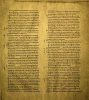
And since we are in Mark 6 now, I will point out that the image I used for the feature on this thread on the home page is from the full image below, which is Mark 6:27-54 (the end of the story of John the Baptist's death, the feeding of the 5000, walking on water) from the Alexandrine Codex, a 5th century CE Greek Bible.

Mark627-54.jpeg
 
Mark 7

Jesus has a dispute with the Pharisees about tradition and God's law.

Jesus is approached by the Syrophoenician woman (of Greek origin) who is seeking healing for her daughter. Jesus initially refuses but is persuaded by her emotional plea and her logic. She goes home to her daughter and finds that the demon has left her.

Jesus heals a deaf mute.

For reflection:

People were astounded and said, "He has done everything well. He even makes the deaf hear and the mute speak." Mark 7: 37 NET
 
He even makes the deaf hear and the mute speak.

Taken figuratively, this is quite relevant to the present day.
 
Mendalla ----you said ----- Unfaithfulness is generally not just lacking faith, but actually "breaking faith".

I say ---I disagree with this statement here -----So this is my take on this -----

I say ---I think understanding how Faith works and what unfaithfulness is in the scripture is needed -----All Faith comes from God ----all people are given a Faith at birth ---it is intellectual faith which relies on the seen realm and is guided by our 5 senses -----so for the people who believe the Scripture you can't break what God has given you ----all have Faith but not all have producing Faith -----you can't break your intellectual Faith that God has implanted in all humans at birth -----but what you can do is keep the Right producing Faith which can change a heart which comes by hearing the word from being inbirthed to change us ----as we see below ---we have a choice to believe what God reveals to us in His word or not ----we decide ---

So unfaithfulness means in the Greek -----/apistéō ("not willing to be persuaded") means more than "disbelieve" ("not believing") because it indicates "refusing to be faithful" (honor a trust or revelation from the Lord).
read here ---https://biblehub.com/greek/569.htm


This is what breaking faith means in the English

https://www.ldoceonline.com/dictionary/break-faith-with-somebody-something

From Longman Dictionary of Contemporary English-----break faith with somebody/somethingto---- stop supporting or believing in a person, organization, or idea How could he tell them the truth without breaking faith with the Party?


I say --in my opinion ----we can break Faith with one another by discouraging another's Faith in God ---and we can break faith with God's Covenant by our unfaithfulness to carry out what is necessary to bring about the right result --Adam broke faith with God's command not God Himself ------

My view on breaking faith

This does not apply here in this scripture because the Faith here is an inbirthing of a Faith from hearing the Divine Word being preached -----it is a heart issue ---not a human issue ----The Word who is Jesus can persuade a change in the heart of the person ---it is a Divine Persuasion ---So I don't think the Jews who were hearing Jesus preach the word were breaking faith with Him the person cause they were amazed by Him and the Miracles he did and His wisdom ----- some were Divinely persuaded in their heart and did have a heart change as some were healed ---some were not because they couldn't get passed the fact that Jesus was just a carpenter etc and took offense by choice toward Him -----so they closed their heart ---and the Divine Persuasion could not penetrate to change them ------

the Greek word for Offense ----4625 /skándalon ("the means of stumbling") stresses the method (means) of entrapment, i.e. how someone is caught by their own devices (like their personal bias, carnal thinking).


I say ----Don't know if this makes sense to you but thought I would give my view on it ----
 
Status
Not open for further replies.
Back
Top