Racism. Please read short article and comment

Welcome to Wondercafe2!

A community where we discuss, share, and have some fun together. Join today and become a part of it!

Justme

Well-Known Member
http://www.dailydot.com/opinion/clueless-things-white-people-say-racism/

This article really made me think. It's written from an American point of view but can easily be applied to minorities in Canada. When I worked in employment equity for a brief period of time, I heard it a lot. I try really hard not to discriminate, although I can catch myself thinking that someone fits a stereotype (especially when I'm driving). A wise woman (the minister at my church) once told me that the people who are dangerous are people who say they're not racist. I was quite upset by her comments because I really didn't think that I was - it really does not matter to me what colour my friends are and I would never move so that I wouldn't have to sit beside someone because of the colour of their skin. But, as Ellie pointed out, if I came across two big Black men, I'd probably wonder about my safety more so than if I came across two White men (and I just realized, I've recently been talking about the lack of people on Detroit streets and noted their race). I'm not really sure what to do to stop this type of injustice or to change.
 
justme - an interesting article.

I sometimes wonder how racist I am. I would like to think I'm not at all. When I rented out rooms to university students, I really liked George (a Nova Scotian of African descent), and didn't care for his friend in the other room (an Acadian). One of my favourite renters was Dukpa (from Bhutan) and my least favourite was a post-graduate student from a west African nation. I liked the young Miqmaq from the north shore, and the older Miqmaq from the Miramichi got on my nerves.

When I was in a car accident (rear-ended by a big Native woman) I felt intimidated - and angry when I found out later that she gave me a false phone number. I think we tend to feel safer and trust those we identify with - people we know or people whose background is similar to ours. So, supposing I am on a lonely part of a walking trail at dusk. I am about to meet somebody. A woman, my age, regardless of colour - safe. A black man about my age - probably safe. A young male of either race - a little bit nervous. Two or more men - I'd probably start to feel uncomfortable and wonder about my safety. Just thinking about this I realize that race, gender, and ageism all enter the picture for me.

 
I grew up in Brantford, ON.

We did not have a huge black population, though it is getting bigger. We had an equally small Indian/Pakistani community. We had a lot of First Nations types.

Mostly I was a white kid in a white neighbourhood being taught in schools filled with white students listening to a white teacher.

If we heard about a car being stolen it was suspected that it would be found at the Rez as a charred husk. That didn't mean it was the crew down at Six Nations who was responsible, it just meant that was where you went to ditch and burn a stolen car. A First Nations team mate of mine simply commented, "why would we stop a white man from wrecking another white man's things?"

At high school, because the student population is much larger I started to come into contact with more non-white citizens of my predominantly white city. We sat in class together. Sweated on the same teams as one another and then the only colours that mattered were the school colours.

Wrestling, as I look back, really helped.

Wrestling is, an intimate sport. You cannot win without touching your opponent and it can't be gentle or fleeting contact either. It must be deliberate and definite.

You spend a lot of time with your face pressed against your opponents flesh. You smell how they smell and at times you taste how they smell. It is never pleasant. It is just part of the sport.

Wrestling taught me that I am as fast and strong as anyone my size. It doesn't matter what colour their skin or how strong their odour.

Most importantly, wrestling was not about harming anyone. It is, for the most part, about strength in control and respect for an opponent. Win or lose you shake hands. Sometimes you lose badly and feel the burn of humiliation and sometimes you win handily and you can empathize with what your opponent is feeling.

That emotion is the same no matter the colour of the gift-wrapping that surrounds it.

I don't fear blacks or First Nations. I trust them as much as I trust other whites. True colours eventually shine through the skin that covers them.
 
I have issues with #3. While in some places it isn't the same, forms of racism can occur to white people anywhere. I prefer to just stick with that term, otherwise ridiculous terms start to get used like reverse racism. There are also places it does occur to white people in the more strict sense of the word.

I think there are issues with #8. Not as worded though. I think when things are bad, it helps people of a group up. As things improve, it starts to hold them back. What does it say when a certain group of people require a lower average to get into the same program as everyone else? How likely are they then to succeed in that program?
 
http://www.dailydot.com/opinion/clueless-things-white-people-say-racism/

This article really made me think. It's written from an American point of view but can easily be applied to minorities in Canada. When I worked in employment equity for a brief period of time, I heard it a lot. I try really hard not to discriminate, although I can catch myself thinking that someone fits a stereotype (especially when I'm driving). A wise woman (the minister at my church) once told me that the people who are dangerous are people who say they're not racist. I was quite upset by her comments because I really didn't think that I was - it really does not matter to me what colour my friends are and I would never move so that I wouldn't have to sit beside someone because of the colour of their skin. But, as Ellie pointed out, if I came across two big Black men, I'd probably wonder about my safety more so than if I came across two White men (and I just realized, I've recently been talking about the lack of people on Detroit streets and noted their race). I'm not really sure what to do to stop this type of injustice or to change.

justme,

want to find out aboot your prejudices in a safe manner?

Go here https://implicit.harvard.edu/implicit/
 
Hmmm.it says it asigns the tests at random - the one I did was about which words I associated with pleasant pictures - I don't see the link with racism, but it's a cool site and one that I will explore again. Thanks for posting!
 
yeah, a lot of racism & prejudice is unconscious (just like most of our thoughts are), so the way the tests work on that site is they are made to avoid anyone being able to 'game the system', that is, consciously avoid their biases...

and all without some internet shamer going 'you're full of privilege'! :3
 
I have issues with #3. While in some places it isn't the same, forms of racism can occur to white people anywhere. I prefer to just stick with that term, otherwise ridiculous terms start to get used like reverse racism. There are also places it does occur to white people in the more strict sense of the word.

I would like to point out something here. I find there is a useful definition and distinction in academia (particularly sociology and anthropology) between racism, discrimination, and prejudice. Prejudice is generally defined as holding biased views about anything in particular. Discrimination is likewise defined as acting on those views especially in relation to other people. Racism (most importantly for this discussion) is usually defined as the systematic enforcement - consciously or unconsciously - of discrimination in favour of the 'race' (race is such a loaded word) that holds the power in a given area.

With that in mind, no, it is not possible for a black person to be racist to a white person in North America. However it could be potentially possible in say, the Congo. The problem is that due to past and ongoing colonial beliefs and standards, as well as internalized superiority complexes (and many more things as well), white people are benefiting from racism whereas black people (for example) are not.

Looking to who benefits and who loses out on a large scale is a good way of differentiating racism from having your feelings hurt.

I think there are issues with #8. Not as worded though. I think when things are bad, it helps people of a group up. As things improve, it starts to hold them back. What does it say when a certain group of people require a lower average to get into the same program as everyone else? How likely are they then to succeed in that program?

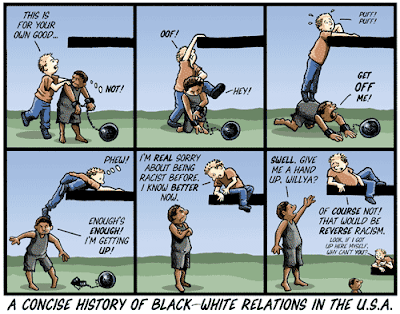
There are plenty of problems with affirmative action-esque programs, both in relation to blacks, immigrant populations, and aboriginal populations, but they were (& are) an attempt to correct the institutionalized disadvantage suffered by the affected groups. Debates about whether they still are useful are ongoing, but are often touchy due to the subject matter and the ongoing oppression of these groups. What is academic for white people could be everyday reality for aboriginal people on an impoverished reserve.

This gives a decent representation of my point regarding affirmative action's purpose.

cartoon4.png


-Omni
 
Also, in regards to your second point, I suppose questions of affirmative action boil down to whether you think the oppressed group is 'on our level' yet or not.

-Omni
 
I would like to point out something here. I find there is a useful definition and distinction in academia (particularly sociology and anthropology) between racism, discrimination, and prejudice. Prejudice is generally defined as holding biased views about anything in particular. Discrimination is likewise defined as acting on those views especially in relation to other people. Racism (most importantly for this discussion) is usually defined as the systematic enforcement - consciously or unconsciously - of discrimination in favour of the 'race' (race is such a loaded word) that holds the power in a given area.
I find the more strict term to be more common in the US, even within academia. In Canada, I do hear racism used more broadly, and systematic used as a qualifier when the specific term is what is meant. When racism is brought up the US context seems to dominate, and maybe it's expanded as a North American issue unless it's a very local discussion. Is it not a global issue? I see huge issues in other countries where the group with the power is not white. I also see the specifics playing out very differently in Canada compared to the US.
 
Back
Top