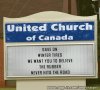
Muslims & Christians: Same God?

Welcome to Wondercafe2!

A community where we discuss, share, and have some fun together. Join today and become a part of it!

I guess what I was getting at were statements that leave little room for doubt, whether they be self-proclamations (John 14:6, Matt 26:63-64), or proclamations others made about Jesus (Matthew 16:16, Acts 4:12). These claims lack nuance in my mind, since they are meant to convey something very clear and important. Contrast these claims with Surah 4:48 - a passage which also shows little nuance.

I think nuance is important when necessary, but not for the sake of being "moderate" alone. Some claims are not "moderate", and are not meant to be watered down. I believe God intended certain truths to be clear enough for even children to understand. Clearly, both Muslims and Christians can't be right at the same time, nor to "varying degrees" on this particular matter. It's pretty *gasp* black and white ;)
 
GeoFee said:
For me the God who inspires and authorizes Jesus by the Holy Spirit has no interest in being top dog when the pack assembles to establish priority and prominence.


So Christ is not the head of the Church?
 
  • Like
Reactions: Geo
@GeoFee

I don't believe it should be about who is right or wrong, like some kind of club where one group exalts itself above another. However, there are very clear cut claims to truth being made by the founders of the major religions (be it Christianity, Islam, etc). Thus, if I believe Jesus' words to be true, I may be right or wrong about it in the end. But I am taking HIS word for it. It's not that I'm right and everyone else is wrong.
 
Post Script:

I have no investment in any doctrine, including trinitarian definitions limiting access to the unity of God revealed in Jesus Christ by the Holy Spirit. In this I have no quarrel with Islam and Judaism. This said, I suspect doctrinally dependant Christians will be uncomfortable with who I am by the will of God.

G
 
Last edited:
Geo said:
I guess what I was getting at were statements that leave little room for doubt, whether they be self-proclamations (John 14:6, Matt 26:63-64), or proclamations others made about Jesus (Matthew 16:16, Acts 4:12).

While it is true that there are statements which leave little room for doubt they stand alongside statements that open the door to faith which may be uncomfortably broader than we tend to think. In much the way the concept of God's grace is much wider than our own understandings for what it means to be faithful or righteous.

If God only inhabits a world of either or then there will never be any kind of statement other than a black and white one.

If God lives in a world of either/or then there are statements other than simply black or white.

Clearly God, in revealing God's self does so for the clear purpose of providing clarity about who God is. Do we, who are less than God, hear and comprehend God's clarity or do we pick an idea we are clear on and attempt to put it in God's mouth?

I'm very clear, and confident that Jesus is the best revelation of God's self that God has given to humanity (that might simply be my own bias). I am not at all clear that those without this best revelation have nothing of God's revelation wise. That would be similar to insisting that Toronto Maple Leafs fans cannot possibly be hockey fans.

I think it is fair to say that all Leafs fans are hockey fans even though it would be unfair to assert that all hockey fans were Leafs fans.

I'm not certain that the same applies to God the Son.

All who worship God the Son worship God the Father. Do all who worship God the Father worship God the Son? May those who refuse to worship God the Son ever manage to worship God the Father?

Whose call, ultimately is it to decide who has worshipped whom?
 
"So Christ is not the head of the Church?" John

The Church with many members, diversely gifted, animated by one Holy Spirit, united by a common purpose as the age ripens for harvest? I affirm Christ, the anointed of God, as the living cornerstone of this temple made of living stones.

The multi-headed Christian institution divided in itself and divisive in the earth now as in history? That would probably be Christ in a mirror darkly.

George
 
@revjohn,

Re your second last question: Apparently not, according to the author of 1 John 2:22-23. And if this isn't a clear, easily understandable statement that's not nuanced, I don't know what is.
 
However if one sees the scriptures as themselves statements of faith and understanding then what the writers have to say is the truth as they see it. (Which would definitively work for an epistle passage). That statement of their truth/understanding thereof does not necessarily mean it is true for everyone.

I remember many years ago (like 30?) hearing Rabbi Harold Kushner speaking about claims about which religion is the best. He likened such claims to love statements -- if he says his wife is the best wife in the world it does not mean that is factually true. I submit that this principle holds true for many of our faith statements.
 
@GordW

But neither Jesus nor the writers of the above passages believed that theirs were mere baseless statements of faith. They believed these "truths" were facts that are binding on all humanity, whether people chose to believe it or not.

In the same way, folks like Kushner believe it is a "fact" that all religious claims to truth are equally valid (which sounds nice, but is a logical impossibility).
 
Beginning Chapter 8, Volf identifies four stark polarities which Christians tend to see between the Muslim God and their own...

1. Islam's God of wrathful, arbitrary will vs. Christianity's God of reason and love.

2. Islam's God who demands unconditional submission vs. Christianity's God who invites a free response of love.

3. Islam's God who commands the enforcement of laws regulating all of life vs.Christianity's God who enjoins love of neighbors and respect for their freedom.

4. Islam's God who is hostile toward any infidel and all enemies vs. Christianity's God who demands love for all people, including one's enemies.

However, according to Volf, A Common Word insists that Islam too is about love of God and love of neighbor. Like Christianity, he says, Islam is a religion of love.

We don’t have a God of spineless love on the Christian side, Volf states, and the God of stern, unbending law on the Muslim side. What we have, he says, is a loving and just God on both sides.

According to Volf, to love means to give. God loved, he writes, so God gave. The same holds true for human love – despite the fact that, he says, unlike God, human beings love with a needy kind of love. According to the Bible, Volf adds, the way to love our neighbor is to follow the Golden Rule.

Both of the most authoritative hadith collections (authentic collections of the sayings of Muhammad), he notes, contain a version of the Golden Rule.

Volf then offers convictions which he says Muslims and Christians share in regard to God’s love...

1. God loves.

2. God is just.

3. God’s love encompasses God’s justice.

4. Human beings should love their neighbors as themselves.

There are, Volf says, affinities in the way Christianity and Islam understand the fine texture of goodness and love. There are differences as well, he admits, though not as deep and not as plentiful as many think.
 
@GordW

But neither Jesus nor the writers of the above passages believed that theirs were mere baseless statements of faith. They believed these "truths" were facts that are binding on all humanity, whether people chose to believe it or not.

In the same way, folks like Kushner believe it is a "fact" that all religious claims to truth are equally valid (which sounds nice, but is a logical impossibility).
How do you know what exactly they believed about what they were writing? THat in and of itself is a faith-based claim that can neither be proven or disproven
 
@GordW

I am taking their word for it of course. Why claim something if you don't believe what you're saying?

In the same way, how can I know what exactly what you believe about what you're writing? Why should I take your word for what you're saying?

It is quite simple, really. If Jesus asks Peter, "Who do you say I am?", and he responds, "You are the Messiah", then I have good reason to believe Peter believed Jesus was the Messiah. Similarly, if Jesus claims to be the Son of God, I have reason to believe that he believes he is the Son of God.

The other thing I am not sure you realize is that your objection that all religions are equally valid is also a statement of faith, since you can't prove that either. Moreover, you can't say that all religious claims to truth are equally valid unless you yourself claim to be able to see above all religious claims to truth (in order to be able to know that). This of course, is self-refuting, since you are attempting to say there are no absolutes from the pinnacle of an absolute.
 
@Pr. Jae

So what is the point of what Volf is saying though? Sure, there are many similarities among many religious teachings. This isn't the issue in my mind.
You can have as many similarities on the finer points as you like, but if they differ on the fundamentals, what does it matter?

From Christian teaching:

1 John 2:22-23: "Who is the liar? It is whoever denies that Jesus is the Christ. Such a person is the antichrist—denying the Father and the Son. No one who denies the Son has the Father; whoever acknowledges the Son has the Father also."

From Islamic teaching:

Surah 4:48: "Verily, God does not forgive the ascribing of divinity to aught beside Him, although He forgives any lesser sin unto whomever He wills: for he who ascribes divinity to aught beside God has indeed contrived an awesome sin."

According to Christian teaching, if you deny that Jesus is the Son of God, you cannot know God. Yet according to Islam, if you make anyone else (ie, "Christ") equal to God, you have committed blasphemy of the highest order, that will not be forgiven. Sounds like no matter what you choose, you're hooped. That is - if you choose the wrong one.

Whether Christians are right or Muslims are right, or indeed either are right, is up for debate. But what we can know is that they both can't be right at the same time. On such fundamental, crucial points, the similarities of the finer points listed above vanish into irrelevance.
 
Last edited:
Nothing like a conversation about who is right and who is wrong. With the bias generally being we (I) are right and others (you) are wrong. This is pertinent not only to the question of Muslim, Jewish or Christian bias but also within the whole spectrum of persons and communities who call on the name of God revealed in the gospel of Jesus Christ by the Holy Spirit.

If our God is different from the others we ought to ask how that difference is made manifest. For me the God who inspires and authorizes Jesus by the Holy Spirit has no interest in being top dog when the pack assembles to establish priority and prominence. Rather, God in Jesus by the Holy Spirit seems more at home in loving service to those excluded by temple functionaries and elites than in those temples; whether in Mecca, Jerusalem or your home town.

George

Good un GEOfee!

Such a poor spirit would be dark arts to the winners of the nuance ... right? Close to the debate going on between the literate monks that wrought the Middle English Bible on Word (manifest thereof) ... while the director and producer was illiterate and didn't know what was inscribed in that dark tome!

Could we call this ghostly beginnings of satyr ... and thus establishment of a Nous theatre of operations ... Shakespearean none-the-less ... a bottom line dog that got QE I St attention? In tradition she too was a tawny owl or a near red thing in the dark!
 
@Pr. Jae

So what is the point of what Volf is saying though? Sure, there are many similarities among many religious teachings. This isn't the issue in my mind.
You can have as many similarities on the finer points as you like, but if they differ on the fundamentals, what does it matter?

From Christian teaching:

1 John 2:22-23: "Who is the liar? It is whoever denies that Jesus is the Christ. Such a person is the antichrist—denying the Father and the Son. No one who denies the Son has the Father; whoever acknowledges the Son has the Father also."

From Islamic teaching:

Surah 4:48: "Verily, God does not forgive the ascribing of divinity to aught beside Him, although He forgives any lesser sin unto whomever He wills: for he who ascribes divinity to aught beside God has indeed contrived an awesome sin."

According to Christian teaching, if you deny that Jesus is the Son of God, you cannot know God. Yet according to Islam, if you make anyone else (ie, "Christ") equal to God, you have committed blasphemy of the highest order, that will not be forgiven. Sounds like no matter what you choose, you're hooped. That is - if you choose the wrong one.

Whether Christians are right or Muslims are right, or indeed either are right, is up for debate. But what we can know is that they both can't be right at the same time. On such fundamental, crucial points, the similarities of the finer points listed above vanish into irrelevance.

If a body deny the light ... would they be dark and entombed? Thus that's ense of Christ at the end of the cave when the tome is opened?

That too would be questioned by folks that wouldn't like people in the dark be enlightened by things obviously now questionable in all stories ... "thus the axiom: question all things" ... denied by many authorities! As the illusion of control by avarice weeps away ... a porcine instant if you've bin poked in the apocalyptic call to move on ... next stage!

You and I are obviously part and parcel of the large Çow ... not really a pig, or cow but a jumped up thought that the emotional were trying to put down while in a state of rising emotional context ... a mental noesi's ... generally unknown due to wishes not to!
 
Can a thing compromised by animal contingents (by conference) change the Nature of Things --- Poggio (one of the isles of piles of Rome; refer to The Swerve ... a tome on how light can be warped) that support the ideal of action-reaction and think that reactions do not have accrued effects if depressed into substandard conditions compared to means an mediums of balance thought ... rare or Eire cases here it seems ? Thus the Jaquez-being process ...

Many say dis believable although they accept that passions come from nothing and nowhere and thus vacuous as de void that's out there! Ethereal thoughts as myths and metaphors to confuse what we really know ... and thus we don't know much. QED
 
"...these "truths" were facts..." Geo

I have read that Jesus taught nothing without the use of a parable and wondered why? Perhaps to admit metaphoric ambiguity where we might prefer factual certainty? The later seems to establish conformity as normative where The former offers opportunity for transformation

George
 
@GeoFee

Respectfully, we must be reading different Bibles then. Where did you read that?

It is quite easy to discern when Jesus is speaking in parables and when he is communicating clear truths. It's not hard to disprove this claim (pretty elementary actually). Examples available upon request.

Of course, for those who seek not to conform to potentially uncomfortable truths, they must find a way to justify twisting the meaning of Jesus' words to whatever they please - perhaps leading to interpretations that are completely opposite to what has been spoken. And if a person wasn't educated in the matter (ie they hadn't actually read a Bible being aware of the various literary devices that are employed) they might actually believe you.

We can be certain that Jesus and his disciples all truly believed what they were saying about Jesus and his claims. Who would be willing to die for a lie?
 
Last edited:
Back
Top