Judas: Who Was At Fault here?

Welcome to Wondercafe2!

A community where we discuss, share, and have some fun together. Join today and become a part of it!

No. He didn't. Go read Exodus again, and pay attention this time.
This is your human understanding your applying here --you go and look up that scripture and do your research on it and you will see that God did not harden his heart ---God allowed him to keep his already hardened heart -----like way as He does with us -----

God did not cause Pharaoh;s hardened heart -----we are not God's puppets ----we have free choice to choose to obey God or defy God ------Pharaoh had that choice and he made his choice ------
 
21 And the Lord said to Moses, “When you go back to Egypt, see that you perform before Pharaoh all the wonders that I have put in your power, but I will harden his heart, so that he will not let the people go.

Read it, and explain how Pharaoh had a choice. Your human understanding of this issue seems to be somewhat suspect.
 
Why does Judas's confession of sin and return of the silver coins not count as repentance? (Matthew 27: 3-5)

Is it because he went to the chief priests instead of turning to God?
My view

His knowing he sinned and gave back the money ----was not a true repentance -----but emotional remorse he felt -----We sin and feel emotionally upset and sorry but we do not have a deep conviction of needing to change our ways of sin --we carry on with our sinful nature ---
-------this was Judas ---in my view

Greek word for remorse
HELPS Word-studies
3338 metaméllomai (from 3326 /metá, "change after being with," and 3199 /mélō, "care, be concerned with") – properly, to experience a change of concern after a change of emotion and usually implying to regret, i.e. falling into emotional remorse afterwards (note the force of 3326 /metá).

True repentance is a complete mind change -----the feeling of remorse is a deep conviction of what was done and a want to change our ways ------
 
My view

His knowing he sinned and gave back the money ----was not a true repentance -----but emotional remorse he felt -----We sin and feel emotionally upset and sorry but we do not have a deep conviction of needing to change our ways of sin --we carry on with our sinful nature ---
-------this was Judas ---in my view

Greek word for remorse
HELPS Word-studies
3338 metaméllomai (from 3326 /metá, "change after being with," and 3199 /mélō, "care, be concerned with") – properly, to experience a change of concern after a change of emotion and usually implying to regret, i.e. falling into emotional remorse afterwards (note the force of 3326 /metá).

True repentance is a complete mind change -----the feeling of remorse is a deep conviction of what was done and a want to change our ways ------
How can you, almost 2000 years later, know what was in the heart of Judas? You sometimes come across as arrogant in your assumptions about people, past and present. Does that mean your heart and mind are hardened against information that contradictsvwhat you want to believe? The Holy Mystery keeps poking me at times with information that pushes me to reflect on what I believed. Are you hardened against messages from God?
 
Ellicott's Commentary for English Readers
(12) The Lord hardened the heart of Pharaoh.—The judicial punitive hardening of Pharaoh’s heart by God Himself now began. As with the heathen in later times, “because they did not like to retain God in their knowledge. God gave them over to a reprobate mind” (Romans 1:28), so now with Pharaoh: because he had twice hardened himself—i.e., resisted an impression made upon him, and crushed his inclination to yield to it (Exodus 8:15; Exodus 8:32),

What your saying is God himself hardened Pharaoh's heart ---and that goes against scripture ----as God Softens hardened hearts -of those who accept God's drawing of them ----our nature hardens our hearts against God ---Pharaoh's heart was already hardened against God and God allowed his heart to remain hardened so his plan could play out -----but God did not Harden his heart ----He himself hardened his own heart against God ------
 
What your saying is God himself hardened Pharaoh's heart ---and that goes against scripture ----as God Softens hardened hearts -of those who accept God's drawing of them ----our nature hardens our hearts against God ---Pharaoh's heart was already hardened against God and God allowed his heart to remain hardened so his plan could play out -----but God did not Harden his heart ----He himself hardened his own heart against God ------
1. I just quoted the passage where God says God will harden Pharaoh's heart. Are you saying that the Bible lied?

2. The bit you quote from Ellicot is about Chapter 9, five chapters later, when God begins to carry out what God said God would do in Chapter 4.

Again, your human understanding of this issue is open to question.
 
Also, I find it interesting whereas, God hardened Pharaoh's heart, Luke says Satan entered into Judas. Any implications?
 
Very interesting discussion about Judas.

What do we think of the others who played roles in the Crucifixion?

Pontius Pilate?
The Jewish leaders and temple police?
The Roman soldiers?
The people who cried, "Crucify him"?

If the death of Jesus was preordained by God, surely they all had a hand in carrying out God's will.

I remember a Good Friday liturgy years ago which looked at the perspectives.of all these characters.
 
Pontius Pilate?
He was actually, if anything, treated a bit more harshly in other historical sources than he was in the Gospels. According to Philo and Josephus, Pilate was responsible for a few clashes between the Roman authorities and the Jews. And an alleged massacre of Samaritans precipitated his dismissal by his superior, the governor of Syria.

Historical views of his role in the trial of Jesus range from the view that the Gospels are wrong, and he did simply condemn Jesus to death without the vacillation we see in the Gospels (which is supported by Josephus apparently) to saying that the Gospels are right that he did not see Jesus as a threat but gave in to avoid being the cause of yet another blow-up with the Jews rather than because he saw any merit in Jesus himself.
 
Pilate's reluctance in the gospels surely points to Jesus's own people being culpable.

Back to the problem that God preordained Jesus's death. Someone had to carry out the execution and many others had to be complicit.
 
What do we think of the others who played roles in the Crucifixion?

Pontius Pilate?

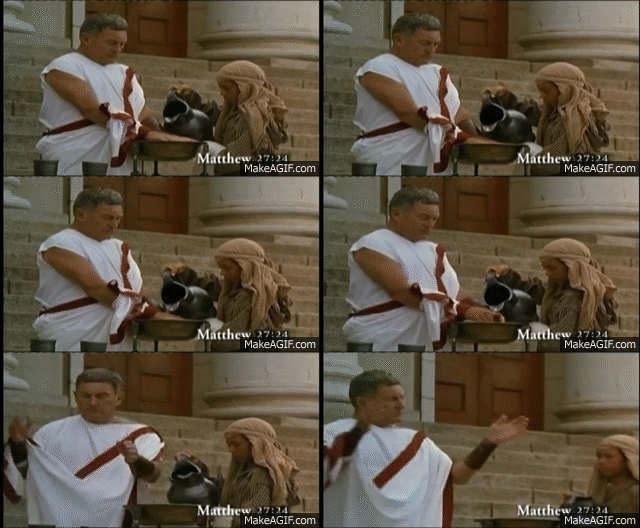
Pontius Pilate didn't want any part of making the decision in crucifying Jesus ---he left it up to the people ----he actually washed his hands of the matter ----

tDMF-M.gif

If the death of Jesus was preordained by God, surely they all had a hand in carrying out God's will.

God's plan of Salvation was definitely preordained -----and so again God allowed all parties involved to remain having their already hardened hearts --remain hardened toward Him so that His Will could be done ----

Jesus gave the Pharisees ---and all people involved many chances to change their ways and turn back to God but they all refused -----and rejected Jesus and His Word and His reason for coming -----

All they wanted was a King to rule over them and they had a King ----King God ------but refused this King ---

The Israelites Ask For a King (1 Samuel 8:4-22)​

Bible Commentary / Produced by TOW Project


God agrees that asking for a king is a bad idea because it amounts to a rejection of God himself, as king. Nonetheless, the Lord decides to allow the people to choose their form of government, and he tells Samuel, "Listen to the voice of the people in all that they say to you; for they have not rejected you, but they have rejected me from being king over them" (1 Sam. 8:7)

I say --
--
They rejected God as their King in the Old Testament and the New Testament ------so God allowed them to reject him as they wished to do ------and today they still wait for their King to arrive -- rejecting God as their King ------

But that will change during the Tribulation period -------
 
Back to the problem that God preordained Jesus's death.
If Jesus' role is to be an atoning sacrifice for human sin, I can't see how you avoid it. He simply cannot go, "Big nope" and walk away or the redemption of humanity fails to happen. If, on the other hand, he was sent to save us through his teaching and example, and the death and resurrection weren't part of the plan beyond Jesus being wise enough to realize the likely outcome of him challenging the authorities, then there's maybe more "free will" involved. Certainly, the whole "Jesus marries Mary and skitters off to have babies" idea is out there, but it flies in the face of everything in both canonical and non-canonical records.
Jesus gave the Pharisees ---and all people involved many chances to change their ways and turn back to God but they all refused -----and rejected Jesus and His Word and His reason for coming -----
But did Jesus even have free will? Could he have chosen to move to another part of the Empire, married, had a family, and left the whole mess in Jerusalem behind? Or was he just as doomed as everyone else in the affair?

I don't buy the whole "Holy Blood, Holy Grail' thing myself, but there are those who do, as shown by the popularity of the book of that title.
 
Still trying to get my head around God's plan for salvation requiring people with hardened hearts to carry out a brutal execution
 
Still trying to get my head around God's plan for salvation requiring people with hardened hearts to carry out a brutal execution
Sort of goes against " thou shalt not kill" and God not believing in sacrifice. Oh that's right, God is the only one that can have people murdered.
 
@unsafe
What would God have done to get the plan carried out if there were insufficient people with hardened hearts?

I have no idea what you mean here ---I think God would be the only one who could answer your Question here -----that my view ---
 
I have no idea what you mean here ---I think God would be the only one who could answer your Question here -----that my view ---
Fair enough. This is the first time I have ever thought about God requiring hardened hearts to carry out God's will.
 
Back to Judas for a minute. What if there had been no Judas leading the authorities to Jesus in his seclusion?

Would it have been a mob scene with lives lost?
 
Back
Top