GENESIS: Snoopy's Short & Snappy Review

Welcome to Wondercafe2!

A community where we discuss, share, and have some fun together. Join today and become a part of it!

Here's another confusing thing. We have nothing to suggest that Sarai is much younger than Abram, and in fact, her pregnancy even later in the book is miraculous. So Abram is 75 when they hit Egypt, and he is worried about 70 something Sarai being a sexual temptress?
In an era where people are living centuries, 70 is just middle-aged, isn't it? Just speculating, though. And, of course, we are pretty sure from archaeology that people were not, in fact, living longer back then. Average lifespans are the longest they have ever been, at least in developed countries, and we are still capping out around 110-120 and that's rare cases. Most are only making it to their 80s or 90s.

The account of the war is interesting. Abram had, apparently, an army of 318 in his household? I see Elam, which was a known kingdom of some significance in the region. Not familiar with some of the others. Wonder if this can be traced to anything known from history or is a mashup of events with some fiction tossed in. Would need to delve a bit into historical and archaeological sources.
 
As for Serai and her (ahem) charms, we know she appealed to Pharaoh because he took her in and lived with her
 
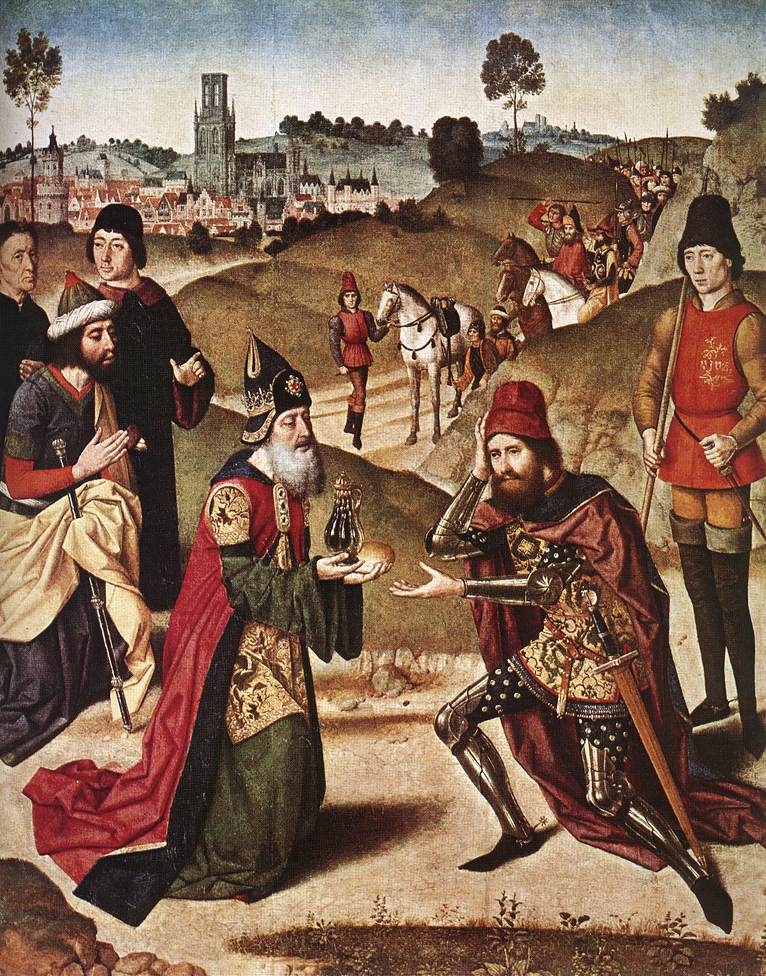
Christians have often taken Melchizedek to be a prototype for Christ. It's not hard to see why.

What do you think of him accepting the tithe from the spoils of war?
Been thinking about this.

Did Abram have divine intervention to secure victory with his army of 318 warriors? Some commentators suggest this is the case. If so, the success of the raid must have been very pleasing to God. Therefore, no problem with Melchizedek accepting the tithe, right?
 
Melchizedek is both a priest of the Most High God and the king of Salem.

Interesting nugget

Strong's Exhaustive Concordance
Salem
The same as shalem; peaceful; Shalem, an early name of Jerusalem -- Salem.


It says that Melchizedek is both a high priest and king of Salem -----


Some Christians hold that Melchizedek was a type of Christ, and some other Christians hold that Melchizedek indeed was Christ.

Reasons provided include that Melchizedek's name means "king of righteousness" according to the author of Hebrews, and that being king of Salem makes Melchizedek the "king of peace".

Heb. 7:3 states, "Without father or mother, without genealogy, without beginning of days or end of life, like the Son of God he (Melchizedek) remains a priest forever."
 
Yes, there is plenty of speculation about Melchizedek and the meaning he holds. There's another theory that he might be an angel.
 
Did Abram have divine intervention to secure victory with his army of 318 warriors?
Yes and this tells you that ===

Genesis 14:20

Amplified Bible​

20
And blessed, praised, and glorified be God Most High,
Who has given your enemies into your hand.”
And Abram gave him a tenth of all [the treasure he had taken in battle].

I think ------The tithe was given as a show of respect and gratitude for his victory over his enemies and rescuing Lot ---- who made a bad decision on where to set up his camp ----
 
Ah yes @unsafe.

The statement about delivering the enemies into Abram's hand is part of the blessing given by Melchizedek. Somehow I missed that or didn't really consider it when I read the passage.

Thanks.
 
Did Abram have divine intervention to secure victory with his army of 318 warriors?
As with safe travel, the norm in most cultures then was to pay tribute to the divine after a military victory. Do we know how big the opposing warband was? If it was a small one, or not much bigger, maybe that tribute was just formality. If this was a "300 Spartans" type situation where the odds were stacked against Abram, then divine intervention would likely be attributed as the source of the victory. There don't really seem to be any details, though, beyond Abram winning and getting Lot and others back.
 
There are commentators who suggest Abram's group of 318 warriors was far outnumbered. But I am not sure how they get this from the text.
 
318 does seem small but I would take it with a grain of salt. Even in "histories" the sizes of armies were often exaggerated for effect, usually to puff up the winner's reputation.

I wonder, though, from the description if it was really a "battle" or more of a raid to rescue the captives. "5 Then, during the night,[ak] Abram[al] divided his forces[am] against them and defeated them. He chased them as far as Hobah, which is north[an] of Damascus." Attacking at night seems odd for a battle in that era, but could be on point for a raid. And dividing a force of 318 does not seem like it would accomplish much in a battle. You could not encircle an enemy with that few people. But for a raid, it could make sense. One party breaches the lines and holds the breach open, another heads straight for where the captives are or something like that.
 
Last edited:
Just for fun I looked up the Number 318.

It is the sum of 12 consecutive prime numbers: (7+11+13+17+19+23+29+31+37+41+43+47)

It is a spheric number which means it is the product of 3 primes:
(2x3x53)

And there are two other facts which are completely over my head. :D

The religious significance is said to be the text we are studying today.
 
Numerology in the Bible is such a fascinating subject, eh. I was kind of thinking that was an unusually precise number but it being the sum and product of math involving primes makes more sense. We have a papyrus from Egypt involving primes that dates to the 16th century BCE and the Greeks were definitely studying them as early as Euclid (300ish BCE). If Genesis was largely written in the Persian and post-Exilic period, the knowledge would have been available to them.
 
There are commentators who suggest Abram's group of 318 warriors was far outnumbered. But I am not sure how they get this from the text.
i think if you read these verses you will see that Abraham had to be out numbered as there were 4 Kings armies involved ------if you read the first part of Genesis 14 ---the Kings are fighting each other in different areas ===so it would be their armies doing the fighting -----not their King's themselves and I am sure they would have many more fighters than 318 that Abraham had -----


8 Then, the king of Sodom, the king of Gomorrah, the king of Admah, the king of Zeboiim and the king of Bela (that is Zoar) went to fight. That was in the Valley of Siddim.

9 They fought against Kedorlaomer king of Elam, Tidal king of Goiim, Amraphel king of Shinar and Arioch king of Ellasar. There were four kings fighting against five kings.

10 The Valley of Siddim had many holes in the ground. The holes were filled with tar. The kings of Sodom and Gomorrah ran away. Some of their men fell into the deep tar. The other men ran away to the hills.

11 The four kings took everything in Sodom and Gomorrah, including all the food. Then they went away.

12 Abram's nephew, Lot, was living in Sodom at that time. So they took him away from there, and everything that belonged to him.


So it seems Abraham is fighting the armies of 4 Kings with only 318 people fighting for him --to rescue Lot -----
 
So it seems Abraham is fighting the armies of 4 Kings with only 318 people fighting for him --to rescue Lot -----
Yeah, it's certainly not unreasonable to think the armies of 4 kings might total more than 318 fighters.

But I saw a commentary which suggested the total of the four armies would have been tens of thousands of warriors. This, I think, is pure speculation.
 
Yeah, it's certainly not unreasonable to think the armies of 4 kings might total more than 318 fighters.

But I saw a commentary which suggested the total of the four armies would have been tens of thousands of warriors. This, I think, is pure speculation.
Which again suggests to me we're hearing about a raid to rescue hostages, not a pitched battle. Or maybe not attacking the four kings full army but some kind of vanguard transporting captives (which might fit the pursuit that is mentioned better than the raid idea). Even the famed 300 Spartans ultimately lost against a vastly larger army, and they only did as well as they did because they were in a narrow pass so that the Persians couldn't bring their full power to bear against them. 318 beating tens of thousands makes no historical sense. Another possibility is an extreme form of the exaggeration I mentioned earlier, i.e. Abram actually had 3180 warriors or something, to make a religious point about God's intervention.

IOW, I think there's some mythmaking going on here regardless of what the history was.
 
This story establishes that Abram has God on his side. He is a force to be reckoned with. Is this the most important aspect of the story?

The rescue of Lot and the blessing by Melchizedek also seem like they could be key points.
 
Back
Top