Extinction Rebellion

Welcome to Wondercafe2!

A community where we discuss, share, and have some fun together. Join today and become a part of it!

Well, yes, the change can come from consumers. There are many things that we can choose to do differently that would have massive effects.

We can say "we refuse to buy this s**t" and then producers will have to do something differently.

This tack IS having a certain amount of effect. When customers speak out against unnecessary packaging some stores start to use less. Food stores are beginning to offer less in plastic bags, for example. Independent stores are opening up that specialize in bulk items where customers bring their own refillable containers. My niece in the UK refills her soap and shampoo bottles and buys bulk laundry powder. This is in addition to her more usual dried fruits and vegetables. She can get hand cream too and bulk cheese (like the stuff sold in my childhood). She gets eggs as well and numerous other things.
 
What I would really like? Electronics that were built to last. Friggin' phones are worst. I used to swear by apple products because at one point they did last longer enough to justify the premium; I don't think that's true anymore.
 
How can producers help with reducing and reusing? I would argue that it is precisely the consumers who will drive it. Those are behaviour decisions. Sure, they can offer reusable store bags and reduce packaging and that sort of thing, but if consumers show that they want those things by taking action themselves, it will help drive the producers. Buy less prepared, packaged food. Use reusable bags or at least reuse the plastic bags (we do). Don't take a bag if you don't need one (I just refused a plastic bag for my takeaway lunch). Don't use a straw if you don't have to (I never do, don't even take a lid unless I'm taking the drink out). Buy an electric car (more demand will drive more manufacturers to make them and will ultimately help drive the price down as supply increases. Yes, when my Civic comes up for replacement, I'll definitely consider it.) Even better, don't buy a car, look at transit or maybe a car/ride sharing service, which will ultimately mean fewer cars on the road. Even the car manufacturers are starting to get behind them. There are all kinds of ways consumer can help drive the agenda towards reducing and reusing instead of waiting for politicians and industries to do something.
It's not going to happen unless the producers are forced to change. There are too many people and too much petroleum products. We may cut down here and there. Some people may completely cut out plastic and petroleum products, some just don't have time or don't find it convenient or cheap enough - they have to buy what's cheapest even though it's plastic - that's reality (I bought a plastic picture stand at Michaels - the wood one was twice the price, the stylized metal ones even more, as a small example. No I didn't need either but I wanted to display a glass plate my friend made for me). They (producers) have us where they want us unless they're forced to change. We asked for goods we need and want. We didn't ask for goods that would be made from materials that kill the planet and be so overproduced there's nowhere for them to go. That wasn't necessary and we could've had nice things without all the plastic junk. If they produced better products we would've bought better products all along. That's on them. One assumes people who own the offending companies and plants live on this planet too. Laws have to change. Don't force the problem on the little guy (the consumers to take on the bulk of the burden). Time to go Erin Brochovich on the companies.
 
Last edited:
One assumes people who own the offending companies and plants live on this planet too.
Might one also assume that the owners of the plastic 'stand' company ... if they are successful ... do not even consider using their own product ... because they can afford not to.

So we here in this forum can all afford to turn down the plastic bag or straw and most of us do (when it is convenient?). Now what if you live in a place where the best employment opportunity is working for the owner of the plastic bag company. Do you refuse the job on principle? The world does not need more plastic bags. Neither does the world need more war machines or for that matter more cars or more cell phones. Yet ... investing in those stocks or working in those factories is what we all do ... capitalism is like that. Capitalism is the problem. But But ... capitalism the sacred elephant in the room ...
 
I don't invest any stocks or own a car (I do get rides in cars from time to time...in Vancouver, most of the people I knew in my neighbourhood for most of the time I lived there, didn't drive cars either. Here, in a smaller city, the transit system is less much efficient.) I get your point and agree that capitalism as we know it (I'm not against a healthy, reasonable, non-wasteful, marketplace - I am against multimegacorporations that have us all slaves to a few billionaires that poison us and the planet.)

Units of production contribute to the GDP - so they just produce and produce - and whether we buy it or not there are many mountains of plastic junk piling up in the world everyday (the products that turn out to not sell very well are still produced first - whether it's in your house or in a liquidation warehouse it's still on the earth and will most likely make its way to a landfill if not recycled and made into something else) and it's unstoppable unless it's regulated and the "market" changes its ways. Companies should be required to use recycled plastics for most things if plastic is actually even required.

Asbestos was banned for the most part. DDT was banned (I think so...I do know there are chemicals no longer in mass use today because they were deemed dangerous). Freon in refrigerators. Mercury. Lead in paint, also. Non recycled plastic should be too. At the point of production - just like refrigerators and home insulation had to be made differently. We moved past all sorts of things that used to be commonly for sale - the same can happen with new plastics. And cars. And energy production.
 
Last edited:
As an OT student, I had to do a two week placement in some kind of a manufacturing industry. I ended up in a place that dealt with buttons. The people would have to sew different kind of buttons on cardboard cards for display, sometimes a button had to be put together by hand, like one that had to have five little glass “ rubies” glued on it. Those cards were meant for sales persons who would present them to the fashion industry.
Yes, there was employment for twenty or so people, but I remember thinking why on on earth we would need all those different buttons.
 
What would all the pretty people do without something ugly to compare to ...? Without contrast would human nature know black from white?
 
Buttons and other pretty things can be made from clay, scraps of wood, stone,glass, animal bones (from animals who were not killed for it like elephants were for ivory) and recycled plastic and other materials that don't hurt the environment. What's ugly is mass produced junk and nowhere to put it all.
 
Greetings. This is a message to Greta Thunberg, from Anonymous.

We understand and sympathize with your concerns about the environment, and agree that the blame lies with many of the world’s most powerful corporations. However, you may want to be careful that you are not led astray by people who are a part of the problem, and it appears that this may be happening. Many of the powerful politicians that you met with and took photographs with, are deeply involved with many of the industries you speak out against.

Many of the policies that you are advocating for are also misguided, despite their seemingly good intentions. For example, heavy carbon taxes will not have much of an effect on the fossil fuel industry, aside from making their cost of doing business a little bit higher. The large corporations that are destroying the planet have teams of lawyers on standby for any accusations that are brought against them, and they have money budgeted specifically for dealing with all of the fines that they intend to violate.

Fines, taxes, and regulations rarely actually cause corporations to do business any differently, but these policies usually do end up hurting average individuals who were never even the intended targets of the policies to begin with. This is because the average person does not have teams of lawyers or money ready for fines.

In the case of carbon taxes, the average person driving their car will be the person who ends up paying the real cost, and it is highly possible that the corporations could make even more money under a model like this. It is also important to consider that just throwing money at a problem is not a feasible solution, especially for something like this. If billions of dollars are funneled into government coffers as the result of some type of “Green New Deal,” what happens next? There doesn’t seem to be any plan for what actually happens to the money, and when plans are actually offered, they typically fall short.


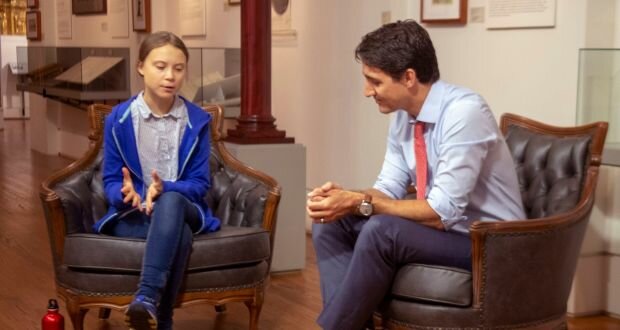
greta.jpg

Photo Credit: Irish Times

For example, Canadian Prime Minister Justin Trudeau, who you recently met with, announced a plan to use money from oil pipelines to plant trees. This does not seem like much of a solution, as many of the native tribes in Canada, who are not very fond of Trudeau’s government, will still be forced off of their land, which they are taking good care of, to make room for dangerous pipelines that are prone to spilling. This type of solution is not much different than the carbon tax idea, it is a small, and likely counterproductive measure that won’t actually address the problems with how humans generate and consume energy, but instead, will just shift around more money through the hands of the ruling class.

It is also important to mention that the environmental impact of war has been entirely left out of many of the recent climate change discussions. The military agencies of the world are responsible for the vast majority of the pollution on the planet, the United States government and their western allies, along with Russia and China, take a large share of the blame for this pollution.

The people who are destroying the planet have names and addresses and they are on the news every single day, but they are never held accountable. In the rare cases where they are held accountable, they usually receive a fine that seems like a large number to the rest of us, but is merely a small percentage of their net worth, so the penalties amount to nothing more than a slap on the wrist.

Protecting the environment is important, but it is also important not to let people who are a part of the problem be in control of the solutions, because we run the risk of allowing them to make everything worse. If you truly do care about the future of the planet, be extremely careful of the people around you, and analyze their solutions very carefully, because you are currently surrounded by some very dangerous people who do not have the best interest of the planet in mind.


We are Anonymous!

 
Importing garbage for energy is good business for Sweden from Sweden on Vimeo.

On the Swedish site promoting WTE, they are proud of the fact that they import waste:

Waste is a relatively cheap fuel and Sweden has, over time, developed a large capacity and skill in efficient and profitable waste treatment. Sweden even imports 700,000 tonnes of waste from other countries.

The trouble is, by any definition of recycling, this is a stretch. In fact, they incinerate about 50 percent of their waste to make heat and energy. And even in their own website, they admit that is not the best approach, that it is not really recycling, and that it takes less energy to actually recycle and reuse than it does to burn and manufacture a replacement from scratch.

Does waste-to-energy make sense?
David Suzuki has another view of the importing:
I toured a WTE plant in Copenhagen
According to the EPA, quoted in Slate,

In summary: Incineration is not recycling, and therefore Sweden does not recycle 99% of its waste.

The Danes and Swedes love their waste-to-energy plants, but we shouldn't be burning garbage or clothing, it is too easy. We should not be making garbage in the first place.
 
If we stick to what is intended under the Paris agreement then during this century and possibly during the next generation this civilization will be finished.

Industrial growth society will be over.

We are talking about collapse.

We are talking about the potential for a series of events that will make the second world war look relatively minor.

We are talking about multiple holocausts.

There is no way to sugar this pill.

This is not a drill.

This is not an economic exercise.

This is about whether anyone under the age of 30 has a future.
 
Business As Usual - Believe It or Not? ...
Pretty funny.

Demand one! Tell the whole truth. Well not the whole truth-just the light your hair on fire end of the world truth. We want panic, because:

Demand two! Net zero by 2025. With today’s technology, the only real way to achieve this is to exterminate 6.5 billion people. So does each person who survives have to kill 7-8 people, or is their organization going to do it for you.

Demand three! We trump government!

Good luck rolling out your crazy platform. Did you notice all the Rambos in the audience?

I get up every morning to a beautiful world. Head out for a nice quiet walk of about an hour. All the birds along my path know me.

I know that the earth is warming at an extremely low rate. But North America used to be covered with miles of ice. Man had nothing to do with the changes. If you come to our place, birds will fly at your face or land on your arm to get your attention. Even with food in the feeders.

This earth could not support 8 billion people if it were not for technology. A man behind a plow can feed his family, it takes Diesel engines to feed the world.

Feed your birds, love the world. Love your fellow man. Avoid people who are willing to exterminate civilization.

We are finding alternatives to fossil fuels. Fission may actually be on the horizon. They can do it, but it still costs more energy than it creates. That is how the oil sands started out as well.

If you double carbon dioxide, the earth greens and soil holds more moisture and plants yield 30 to 40 percent more. So it is not all bad.

Well, unless you go with extinction rebellion demands. They are demanding extinction.
 
Thus things must Deis before learning anything about change ... all the trumped up are excluded!

"S" is for a weird measure of Q/T ... measuring disorder as entropy ... a quality endogenous tp mysterious voids ... Black Holes?

The religious wouldn't go that far ... blind faith suits them ... no questions please!
 
I just think if you want to be taken seriously, you have to approach it seriously. Net zero by 2025...

What’s the plan? If solar energy was as powerful as these people think it is to take over from fossil fuels, we would burst into flames every time the sun hit us. What’s the plan? Elon Musk is feverishly pumping out batteries to store all this energy from solar and wind. Lots of mining and energy and resources for batteries that are still not that great and very expensive. And full production for a year equals enough energy storage to keep the lights on in the US for 2 minutes. So what’s the plan?

Talk talk talk - no plan. Infant minds with pixie dust who want to have control of the environment? The only reason we are here today in Canada is because we have mastered the climate. Thank you fossil fuels. But seriously, what’s the plan. Baby steps, right? Well... I think I could give up plastic straws. And therefore we can all live happily ever after on wind and solar. See? Fixed it! High five!
 
There is no real evidence of an impending apocalypse. The 30’s were hotter than today. But the graph they show you has the 30’s much cooler than today. They haven’t yet destroyed all the archives, so you can look for yourself. But they know you won’t because you believe what you are told.
 
Back
Top