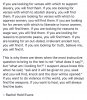
'Bible Believing?'

Welcome to Wondercafe2!

A community where we discuss, share, and have some fun together. Join today and become a part of it!

I was talking about this today.

Peter, and his references to the Rock, gives a real foundation to the "top down-ness" of Catholicism, in stark contrast to the irritatingly "bottom up" workings of the United Church.

Well, except that interpretation is, itself, irritatingly literal by suggesting it is Peter himself, not Peter as an example of faith, that is the rock. I agree the RCs did a good job of finding an interpretation that suited and supported their governance structure but I hardly think it reflects what Jesus had in mind if/when he said that.
 
But which Canon do YOU receive?

(You do realize, I hope, that the Canon is actually the result(s) of human committees making their best choices? Actually several different committees, as the several different Canons attest.)

You were right, though. The blurb from Bible.org didn't help you answer the question.

I find it quite funny that "canon" has been adopted in pop culture to refer to the "official" timelines, etc. for fictional universes like Star Wars and Star Trek. Given how fraught with debate and controversy the "canon" in Christianity has been, it's almost the wrong model to follow. Then again, some of those fictional "canons" have been fraught with debate and controversy, too, even though they had living creators to set them.

(e.g. George Lucas used to say that only the Star Wars films were canon; the novels, comics, etc. were an "expanded universe" that he was not obligated to follow or even pay attention to. Eventually, he accepted the Clone Wars TV series as sort-of canon, too. Then Disney took over Lucasfilm and completely redefined the canon.)
 
When it comes to "canon", did the early Christians have or want that? As far as I know they reached for various books for their learning (the book called the Shepherd of Hermas was one of them.....which was supposedly written by one of the Apostolic fathers) and nothing needed to be put into a New Testament until much later. Do we know if the disciples were actually thinking this way as far as getting rid of some of these books? Or were they more accepting of the diversity within the books?

So there were supposedly 5 Apostolic Fathers that were called so because they knew and talked to the apostles. What they wrote was widely read in the early church and but most didn't make it into the canon.
 
Last edited:
When it comes to "canon", did the early Christians have that? As far as I know they reached for various books for their learning (the Shepherd of Hermas was one of them.....who was supposedly one of the Apostolic fathers) and nothing needed to be put into a New Testament until much later. Do we know if the disciples were actually thinking this way as far as getting rid of some of these books? Or were they more accepting of the diversity within the books?

I don't think it happened that early, given that books were still being written until around 100CE. So by the time things started shaking out and the discussions that led to canonization began, we were definitely past the era of the disciples. Without doing some reading, though, I am not sure whether there was a shakeout over time or if it happened fairly quickly in the era prior to the canon being established. Wiki says that Marcion of Sinope wrote the first surviving attempt at a canon sometime in the 130s CE and the canon we know was established closer to 400 CE so it does seem to have developed over time. And, of course, the variant canons each have their own timeline.

 
I don't think it happened that early, given that books were still being written until around 100CE. So by the time things started shaking out and the discussions that led to canonization began, we were definitely past the era of the disciples. Without doing some reading, though, I am not sure whether there was a shakeout over time or if it happened fairly quickly in the era prior to the canon being established. Wiki says that Marcion of Sinope wrote the first attempt at a canon sometime in the 130s CE and the canon we know was established closer to 400 CE so it does seem to have developed over time. And, of course, the variant canons each have their own timeline.

I edited and added a mention of the apostolic fathers who were widely read in the early church because they knew the disciples.....but their work is not part of our bible.
 
I edited and added a mention of the apostolic fathers who were widely read in the early church because they knew the disciples.....but their work is not part of our bible.

I think the whole concept of canon is wrong-headed to some degree. Hinduism has a massive pile of texts ranging from the Vedic Hymns through to modern Hindu thinkers like Gandhi. Yes, some get more attention than others and various schools of Hinduism follow particular ones, but there's no overarching canon like we have in the various branches of Christianity. The counterpart in Christianity would be accepting everything from Paul's earliest letter through to at least Augustine as usable texts, including all the variant gospels. You'd end up with something more like modern Protestantism than the monolithic Roman Catholic Church, but I think that's a good thing. It means people engaging with the sources of the tradition and learning for themselves rather than been shepherded about by a hierarchy or charismatic leader.
 
BetteTheRed ------you say ---And it actually matters a great deal. The Catholic understanding of purgatory relies completely on Maccabbees.

I say
Not just the Maccabbees ----there are scripture in the Written word that Catholics use as well ----to maintain there false doctrine of purgatory ---

from google -----
Roman Catholic Christians who believe in purgatory interpret passages such as 2 Maccabees 12:41-46, 2 Timothy 1:18, Matthew 12:32, Luke 16:19-16:26, Luke 23:43, 1 Corinthians 3:11-3:15 and Hebrews 12:29 as support for prayer for purgatorial souls who are believed to be within an active interim state for the dead ...
 
I think the whole concept of canon is wrong-headed to some degree. Hinduism has a massive pile of texts ranging from the Vedic Hymns through to modern Hindu thinkers like Gandhi. Yes, some get more attention than others and various schools of Hinduism follow particular ones, but there's no overarching canon like we have in the various branches of Christianity. The counterpart in Christianity would be accepting everything from Paul's earliest letter through to at least Augustine as usable texts, including all the variant gospels. You'd end up with something more like modern Protestantism than the monolithic Roman Catholic Church, but I think that's a good thing. It means people engaging with the sources of the tradition and learning for themselves rather than been shepherded about by a hierarchy or charismatic leader.
And that's sort of why I do read the books left out......I've started reading the Shepherd of Hermas that was widely read closer to the beginning of Jesus' teachings. So far the interesting thing in that book is that AFTER YOU'RE BAPTIZED you have a chance to be forgiven for all you've done but that's it. You are to live a Christian life after you're baptized and I guess you shouldn't need any more forgiveness if you do. They say it may explain why Constantine was baptized before he died......and it wasn't just him.....they found a loophole with that teaching I guess.
Of course none of that jibes with what we know as modern Christians.......so it's either been changed or this was something else that applied to only some churches teachings....I don't know.
 
I agree the RCs did a good job of finding an interpretation that suited and supported their governance structure

You're right, but Jeez, Louise, it's easier.

OTOH, it could be worse. We largely work on developing consensus, but still use a numeric vote at meetings, and there's the odd dissenter of the odd motion. I know a local united church that has mandated consensus decisions, and all I know is that I'd avoid that Board like the friggin' plague.
 
You're right, but Jeez, Louise, it's easier.

OTOH, it could be worse. We largely work on developing consensus, but still use a numeric vote at meetings, and there's the odd dissenter of the odd motion. I know a local united church that has mandated consensus decisions, and all I know is that I'd avoid that Board like the friggin' plague.

Such governing by armed mob of the other kind is Con Stanteen; a tine in the R's when in the hands of those concerned with booty instead of beauty of the more gentile SOL ... and taxes for the well-SET can be diminished ...

SET was a burning character in Egyptian archaeology ... a falling flame as nemesis? What goes up ... as an alternate ... be subtle as a Pa*Rabble ...
 
You're right, but Jeez, Louise, it's easier.

OTOH, it could be worse. We largely work on developing consensus, but still use a numeric vote at meetings, and there's the odd dissenter of the odd motion. I know a local united church that has mandated consensus decisions, and all I know is that I'd avoid that Board like the friggin' plague.
FOr actual consensus to work you need people to buy in to the idea that they might have to give up their "perfect" position for the communal good. That can be a challenge.

At the same time I once had a prof in seminary opine that sometimes with consensus you get a lowest common denominator decision (that everyone can live with) rather than the best possible decision.
 
I am not overly familiar with Evans beyond having heard her on a podcast or two. Did she understand that that statement basically says "the Bible is just another book"? That we no more need it than we need the Gita or the works of Plato or "Man's Search for Meaning"? Because you can apply that quote to basically any work of inspirational/spiritual content and come to the same conclusion.
 
I believe the quote is addressed to those who would claim 'The Bbile CLEARLY teaches X'. While one passage in that vast collection of literature may indeed favour X, there is more than likely a passage elsewhere that just as clearly may favour 'Not X.' I read her statement as meaning that the Bible is, in fact, in dialogue with itself, later voices often re-imaging what earlier voices meant, as time and circumstance change In part, I see it as a rebuttal to those who would cherry pick passages that suit their purpose at the moment, and try to build that solitary passage up as The Universal Truth For All Time and All People, God Said So, End of Discussion, PERIOD. (You may have noticed we have a few such people among us here.)
 
And clearly, the more books you have to choose from, the wider an array of points you have for discussion of any position.

I often think that it's not wise of us to use Torah without Talmud.
 
I believe the quote is addressed to those who would claim 'The Bbile CLEARLY teaches X'. While one passage in that vast collection of literature may indeed favour X, there is more than likely a passage elsewhere that just as clearly may favour 'Not X.' I read her statement as meaning that the Bible is, in fact, in dialogue with itself, later voices often re-imaging what earlier voices meant, as time and circumstance change In part, I see it as a rebuttal to those who would cherry pick passages that suit their purpose at the moment, and try to build that solitary passage up as The Universal Truth For All Time and All People, God Said So, End of Discussion, PERIOD. (You may have noticed we have a few such people among us here.)

But really, you have to end up at the Bible as a whole is not "The Universal Truth For All Time and All People, God Said So, End of Discussion, PERIOD" if you follow that line of reasoning to its end conclusion. It sits on a very big shelf of other books of purported wisdom but no one is obligated to accept or follow any of it save that they take on that obligation by professing a faith based on The Bible. No one can go to a Hindu and say, "You're wrong because the Bible says so." The myriad Hindu scriptures are 100% as true (and untrue) as The Bible. Which, lets face it, is the conclusion that even some mainstream Christians, let alone evangelicals and fundamentalists, dread. Losing their exclusivity is a blow to their raison d'etre for some.
 
No one can go to a Hindu and say, "You're wrong because the Bible says so."
I know some people who would try exactly this...

Losing their exclusivity is a blow to their raison d'etre for some.
Yes, that seems to be their biggest fear, that they won't be special anymore. It might ruin their weekend to realize that the divine love is, as one hymn writer put it, 'broader than the measure of the mind.' Somehow they manage to equate 'God loves everyone' with 'God loves me less'. If it isn't exclusive to just 'our group', then somehow it just doesn't count for anything at all.
 
Beyond special ... is where "X" marks the spot that is unknown ... and what really do we know about a bible that contains everything ... and some unknowing folks state that everything is in the bible ....

Thus God and ... everything connected!
 
Back
Top