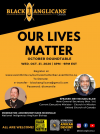
I am not sure what needs to be done at all. And no, it's not ignoring the subject but rather trying to find the proper response.
We have started by creating four sub-committees that are looking respectively at the historic aspect, the current problems we have, education (in its broadest sense) and ways to better connect with each other and celebrate our diversity. Here are a few problems that came in over the Summer and a very personal view on that.
1. History. It is important to know where we come from, if only to remind ourselves that we were and still are far from perfect. A lesson of humility is never bad! Still, we must remember what was the general culture in 1800 and early 1900, and we must not beat ourselves ad infinitum with what was done in the past. Especially the far-away past. We need to use it to learn lessons.
2. Identifying current problems. The main issue is to get people to speak up. We have a very diverse congregation, but what can we do when Black people tell us that "everything is fine"? Is it really fine, is it because we are just a tad better than the rest of society or is it because people are afraid to speak or desensitized about various issues? We found that's a more important issue with blue collar workers or even scientists than with people working as "professional organizers".
One of the problems we have is that the reality of our Black Francophone congregation seems different than that of our Black Anglophone congregation. Generally speaking, different neighbourhoods, different jobs, different age bracket, shorter presence in our parish.
For those who are doing accident inquiries on the workplace, I would say the process is similar to it, in that we need to put people in confidence and have open and unbiased questions rather than closed ones.
3. Education. What and how we do it?
We have found books and films in both languages that will be used for self education. And we will have a couple of presentations on history, for example. And to complicate education, our Black members of either language are generally the least bilingual people of our congregation (that's oversimplification, but it still gives you an idea).
But apart from history, what kind of "education", "training" or discussion do we want to have? We want to keep most of our discussions on improving our Church, but some of it should spill out in society: either through our work in the community or somewhere else. What we want to avoid is blaming people and generalization. My personal experience with on-the-job training and one of our priest's former experience in US on a touchy subject is that we get the most effective results when we address real problems and do hands on training (applies to on the job training). That's why item 2 is important. We don't want to say that "White people are like this or like that", but rather that we have this specific problem to address and here are ways to address it. We can't "practice", but the next best thing will be to discuss issues so that everyone is involved in the process.
4. Building a better integrated community. That probably will work better in 2022 or 2023