Pavlos Maros
Well-Known Member
- Pronouns
- He/Him/His
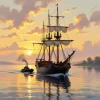
This is going to be a tangent that’s a little off the wall perhaps. As we were discussing AI in our last tangent this is basically the subject but it is about certain AI program image creators like Mendalla uses. What came to mind this time was you have to provide a written prompt for it to generate an image. Which got me thinking how much info does it need to create an image. So I decided to test my theory, I took a very famous image The Fighting Temeraire (1839) by JMW Turner and not giving it any clues like the title or the name of the artist, I gave it this prompt:
“A large pale warship with tall bare masts being towed by a small dark steamboat across calm water, golden sunset sky with soft clouds, misty atmospheric lighting, romantic painting style.”
Now the image is no Turner but it isn’t half bad considering. With a little more tweaking on the prompt it could probably create a Turner-esque image.
What struck me though was that this experiment suggests something bigger. A painting like The Fighting Temeraire doesn’t just live in its title or its artist’s reputation. Its essence can be boiled down to a kind of visual grammar that still carries across when you strip away context. The art program with no knowledge of Turner or the ship, could still generate an image that felt recognisable. That says a lot about how scenes are structured in our minds, how light, composition and subject matter combine into something iconic.
Of course it couldn’t capture Turner’s loose brushwork, his hazy atmosphere, or the bittersweet emotion of an old warship being towed to its end. Those are uniquely human touches. But the bare bones of the image survived translation into pure description. and as said who knows with a little more tweaking on the prompt what could be created. That fascinates me. It makes me wonder whether we could reconstruct other famous works in the same way. Imagine describing a woman with a half smile in front of a winding distant landscape, would the program unknowingly conjure something close to the Mona Lisa?
Maybe this shows that what we think of as cultural masterpieces also live in a deeper layer of human perception, one that can be encoded in words, shapes and moods. And that is exactly what makes this tangent worth chasing down.
What do you think.
(I put the picture it created below)
“A large pale warship with tall bare masts being towed by a small dark steamboat across calm water, golden sunset sky with soft clouds, misty atmospheric lighting, romantic painting style.”
Now the image is no Turner but it isn’t half bad considering. With a little more tweaking on the prompt it could probably create a Turner-esque image.
What struck me though was that this experiment suggests something bigger. A painting like The Fighting Temeraire doesn’t just live in its title or its artist’s reputation. Its essence can be boiled down to a kind of visual grammar that still carries across when you strip away context. The art program with no knowledge of Turner or the ship, could still generate an image that felt recognisable. That says a lot about how scenes are structured in our minds, how light, composition and subject matter combine into something iconic.
Of course it couldn’t capture Turner’s loose brushwork, his hazy atmosphere, or the bittersweet emotion of an old warship being towed to its end. Those are uniquely human touches. But the bare bones of the image survived translation into pure description. and as said who knows with a little more tweaking on the prompt what could be created. That fascinates me. It makes me wonder whether we could reconstruct other famous works in the same way. Imagine describing a woman with a half smile in front of a winding distant landscape, would the program unknowingly conjure something close to the Mona Lisa?
Maybe this shows that what we think of as cultural masterpieces also live in a deeper layer of human perception, one that can be encoded in words, shapes and moods. And that is exactly what makes this tangent worth chasing down.
What do you think.
(I put the picture it created below)