Is SCIENCE!!!! still weird and cool in 2025? You betcha.

Welcome to Wondercafe2!

A community where we discuss, share, and have some fun together. Join today and become a part of it!

Using D&D to discuss a mathematical formula for group dynamics is about as geeky as it gets. But the problems of organizing a set group for regular, recurrent meetings is a challenge that DMs face, as well as folks like me in the business world. Negotiating meeting times can be an exercise in frustration at times. Hank Green, a roleplayer and business executive (his company produces SciShow, Eons, and other science-focused YouTube channels and shows), knows this well and has an explanation.

 
Just imagine Game theory in Greek where Gama is for dark and mysterious ... like the lady with the long fetters and entanglements ... rob ET?
 
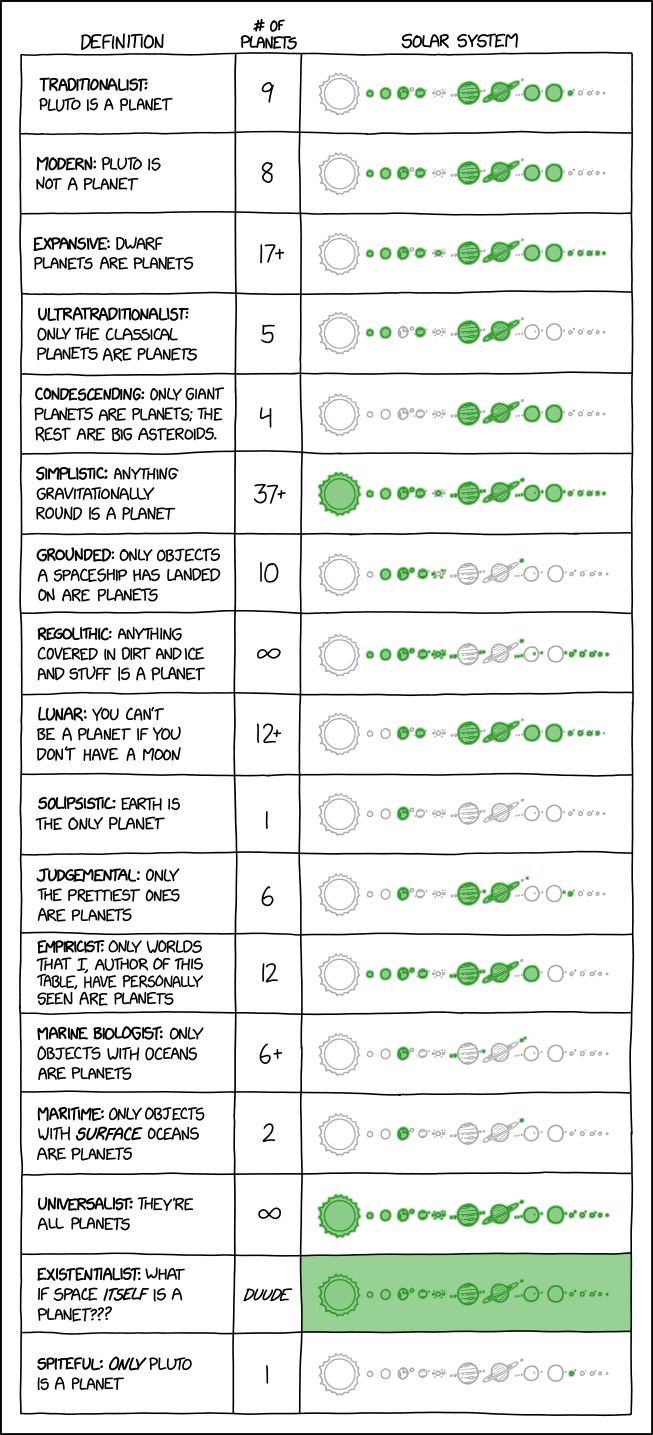
First up, some science humour from Randall Munroe, former NASA contractor with a degree in physics who became a science and technology humourist par excellence.

planet_definitions.png
 
And I will follow that up with a recent SciShow about the world's highest (above sea level) mountain, Sagarmatha or Qomolangma, better known to us Westerners as Mount Everest. They discuss why it is so tall to start with and then look at the rather amazing fact that the dang thing IS STILL GROWING!!!


Did sugars come from space? Well, we don't know, but they could be out there based on some research done after the New Horizons probe visited the Kuiper Belt asteroid Arrokoth. And no, they didn't have to prick its finger (diabetes humour).


Speaking of molecules important to life being found out there in space, here's the story on some fascinating findings from the OSIRIS-Rex sample return mission to the asteroid Bennu.

 
Organic is sometimes taken as carbonized and thus toasted to ... causing questions about inorganic sects in belief systems that are cold ...
 
Warning arachnophobes! Our next story from PBS Eons is about the eight-legged demons of your nightmares, aka spiders, and how they came to be what they are today. The ancestors of modern arachnids go back a long way, and so does their predator-prey relationship with insects and their ancestors. In fact, the two seem to have possibly driven each other's evolution to some degree. Insects took flight to enable them to escape ground-dwelling arachnids, arachnids responded by making webs that could catch the flying bugs. The Cold War but with more legs.

 
Last edited:
Speaking of bugs and suchlike, there's been a lot of talk about spotted lanternflies in recent years. Here's the full story from Scishow.

 
From astrophysicist Matt O'Dowd of PBS Spacetime, a story on exactly how scientists work out the risks once a Near-Earth Object (e.g. the recent asteroid discussed upthread) is located. It's quite a complex process and he explains nicely why the probability kept changing as they collected and analyzed more data.

 
This is cute

guy builds a mini TARS from that fun movie Interstellar and adds in Chatgpt

funfunfun

he has a whole channel


TARS was my fav char in the movie
 
Thought this piece from SciTechDaily was interesting. Some scientists have figured out that there was an event around 41,000 years ago that weakened the Earth's magnetic field. Since this would have allowed more UV and other solar radiation through, they are suggesting that maybe (but not definitively) this might have impacted Neanderthals more than homo sapiens because, they theorize, homo sapiens had more technologies that could help protect them, e.g. fitted clothing and use of ochre as sunscreen. It seems like an interesting idea but not sure it is verifiable or will stand the test of time. Discovering that Neanderthals had those technologies, for instance, would kind of falsify the hypothesis. Of course, they also make the quite valid point that a similar event in our high-tech world could be devastating given the impact that more high energy particles from the sun getting through would have on electronics and electrical systems.

 
I am overdue to add some content here. So here's some science-y bits.

I have actually been to the Arenal region of Costa Rica. Did not realize at the time how recently Arenal volcano had been active, though. We hit a hot spring fuelled by it's magma (I think) and spent some time in the jungle around it.


Paleontology student Ben Thomas is usually more of a dinosaur geek but here he looks at some intriguing genetic work on human evolution. Besides some modern humans having Neanderthal and Denisovan DNA, there's some hints that we got some from even earlier hominin species as did those two. Homo erectus seems an obvious possibility but with no Erectus genome (they are too old so their DNA has deteriorated), it's hard to tell.


And the leadoff story on last week's 7 Days of Science has had us classicists a bit giddy. While we have plenty of ancient art portraying humans fighting animals in the Roman games and some literary accounts, there has never been an actual archaeological finding to back those up. Now we have one. A human skeleton from a Roman graveyard known to contain gladiators has puncture wounds on the bones consistent with a big cat. Nice.

 
We went to Arenal while we were in Costa Rica. The resort with the hot springs at the foot of Arenal was really cool with its several pools heated by the volcano. We crossed a river west of the resort with water heated by the volcano. The land is high enough that it is a rain forest. The higher parts of the volcano were hidden by clouds when we were there.
 
We went to Arenal while we were in Costa Rica. The resort with the hot springs at the foot of Arenal was really cool with its several pools heated by the volcano. We crossed a river west of the resort with water heated by the volcano. The land is high enough that it is a rain forest. The higher parts of the volcano were hidden by clouds when we were there.

Such it is ... when some get their upper parts in a mist ... the hedonic sign ...
 
i've got this playing as a theme song for this thread


by Kriss Drummer (her youtube handle)
Check her oot, you might like some of her stuff, RockinApe
 
Sabine Hossenfelder this time talks aboot a twisty problem called the Andromeda Paradox, essentially, when is Now?

 
I have a love-hate relationship with Sabine. Smart and some of her stuff is fantastic but there's also times when she seems to be contrarian for the sake of being contrarian which is something that always bugs me.
 
Nice piece from PBS Eons looking at how oddities in the fossil record helped us figure out plate tectonics. And it all started in Newfoundland, of all places.

 
Back
Top