August 4, 2024 (Sunday)
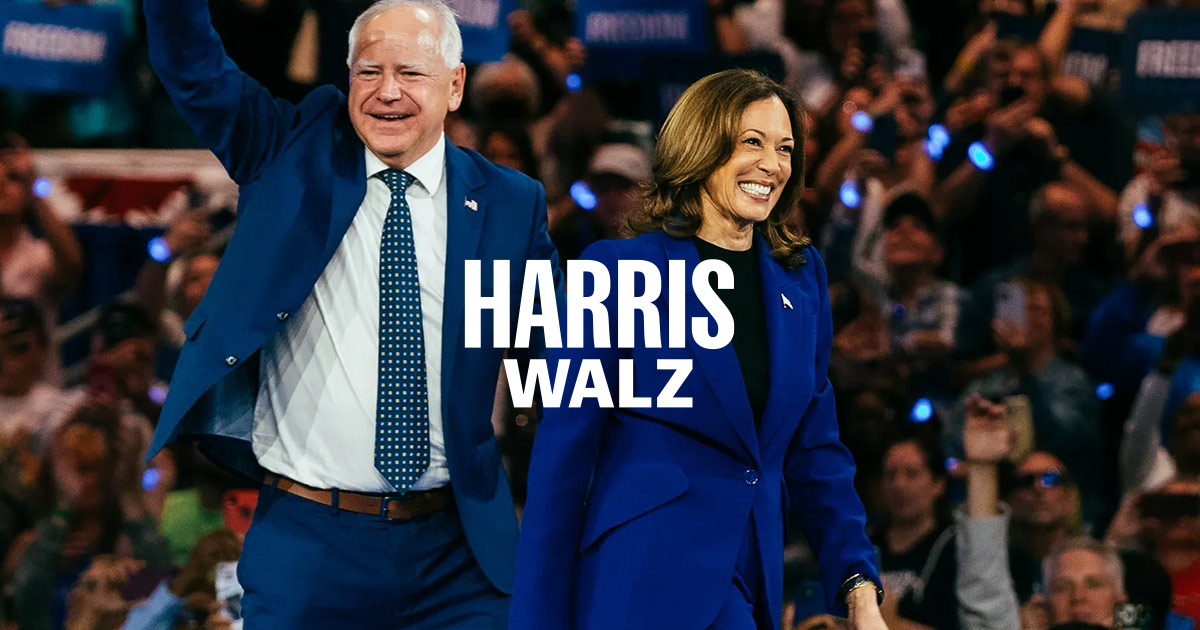
To some fanfare, Vice President Kamala Harris’s campaign today launched Republicans for Harris, which will kick off with events this week in the swing states of Arizona, North Carolina, and Pennsylvania. Their goal, campaign officials told Zeke Miller of the Associated Press, is to make it easier for Republican voters put off by Republican presidential nominee Donald Trump to back Democratic presidential nominee Harris. Curiously, though, in their embrace of the nation’s growing democratic coalition, Republicans crossing the aisle in 2024 are returning to their party’s origins.
The Republican Party itself began as a coalition that came together to stand against an oligarchy whose leaders were explicit about their determination to overthrow democracy. As wealth had accumulated in the hands of a small group of elite southern enslavers, those men had turned against American democracy. “I repudiate, as ridiculously absurd, that much-lauded but nowhere accredited dogma of Mr. Jefferson, that ‘all men are created equal,’” South Carolina senator James Henry Hammond said.
Enslaver George Fitzhugh of Virginia rejected the other key principle of the Declaration of Independence: that everyone has a right to a say in the government under which they live. “We do not agree with the authors of the Declaration of Independence, that governments ‘derive their just powers from the consent of the governed,’” he wrote in 1857. “All governments must originate in force, and be continued by force.” There were 18,000 people in his county and only 1,200 could vote, he said, “ut we twelve hundred…never asked and never intend to ask the consent of the sixteen thousand eight hundred whom we govern.”
Enslavers like Hammond and Fitzhugh believed that some people were better than others and had the right—and the duty—to impose their will on everyone else. If they did not, men like Fitzhugh believed, poor men and marginalized people would insist on being equal, receiving the value of their work and living as they wished.
Under this dangerous system, Fitzhugh wrote, “society is insensibly, and often unconsciously, marching to the utter abandonment of the most essential institutions—religion, family ties, property, and the restraints of justice.” He defended human enslavement as the highest form of society, since paternalistic Christian masters would care for their wards, preventing a world of “No-Government and Free Love.”
The elite enslavers came to control the Democratic Party and, through it, the Senate, the White House, and the Supreme Court. The Whig Party tried for decades to make peace with the increasingly extremist southern Democrats, and as they did so, the party splintered, with those opposed either to human enslavement or the spread of human enslavement to the West—those were actually not the same thing—creating their own upstart parties.
And then, in 1854, with the help of Democratic president Franklin Pierce, elite enslavers managed to push through the Senate a bill to organize the two giant territories of Kansas and Nebraska in such a way that they would be able to spread their system across the American West. The new slave states that would form there would be able to join forces in the House of Representatives with the southern slave states to outvote the northern states that rejected enslavement. Without a brake on their ambitions, the enslavers would be able to spread their worldview across the nation. From their position at the head of the United States, they expected to spread their slave-based economy around the globe.
But their triumph was not to be. With the bill under debate in the Senate, Democrat Amos Tuck of New Hampshire—the state Pierce hailed from—wrote: “Now let Frank Pierce consummate his treason, if he dare. There is a North, thank God!... We have…rebuked treason, condemned the Nebraska Bill, and discarded the President.” Tuck noted that the Democrats were losing “their best men. I think they (the leaders) can never recover from the consequences of having tried to betray their country.” He looked forward to “bringing out in future the true characteristics of our people, so long belied by the most unworthy demagogues….”
Tuck was not alone. The day after the House of Representatives began to debate the Kansas-Nebraska bill, Whig representative Israel Washburn of Maine invited about thirty antislavery representatives to meet at the rooms of his friends, Massachusetts representatives Thomas D. Eliot and Edward Dickinson (whose talented daughter Emily was already writing poetry), in Mrs. Crutchett’s select boardinghouse in Washington, D.C. The men who called the meeting were northern Whigs, and the men who came to it entered the elegant room as members of a variety of political parties, but they all left committed to a new northern organization that would stand against the spread of slavery into the West. They called themselves “Republicans,” hoping to invoke Thomas Jefferson—who had called his own political party Republican—and recall the principles of the Declaration of Independence.
When the House passed the bill on May 22 and Pierce signed it on May 30, the anti-Nebraska movement took off. Conventions across the North called upon all free men to fight together “for the first principles of Republican Government and against the schemes of aristocracy, the most revolting and oppressive with which the earth was ever cursed or man debased.” There were 142 northern seats in the House of Representatives; in the midterm elections that year, voters put “anti-Nebraska” congressmen in 120 of them. Anti-Nebraska coalitions elected 11 senators and swept Democrats out of state legislatures across the North.
In 1855, Pierce insisted that Americans opposing the spread of human enslavement were trying to overturn American traditions, insisting that the United States was a white man’s republic and that the Founders had intended to create a hierarchy of races.
But those coming together to oppose enslavement denounced Pierce’s recasting of American history as “False all through!” As for the Founders, Chicago Tribune editor Joseph Medill wrote, “their ‘one guiding thought,’ as they themselves proclaimed it, was the inalienable right of ALL men to Freedom, as a principle.”
When Democrats tried to call those coming together as Republicans “radicals,” rising politician Abraham Lincoln turned the tables by standing firm on the Declaration of Independence. “[Y]ou say you are conservative—eminently conservative—while we are revolutionary, destructive, or something of the sort,” he said, addressing the Democrats who remained determined to base the United States in enslavement.
“What is conservatism? Is it not adherence to the old and tried, against the new and untried? We stick to, contend for, the identical old policy on the point in controversy which was adopted by ‘our fathers who framed the Government under which we live’; while you with one accord…spit upon that old policy, and insist upon substituting something new…. Not one of all your various plans can show a precedent or an advocate in the century within which our Government originated.”
When voters elected Lincoln president, the fledgling Republican Party turned away from a government that catered to an oligarchy trying to overturn democracy and instead reinvented the American government to create a new, active government that guaranteed to poorer men the right to be treated equally before the law, the right to a say in their government, and access to resources that had previously been monopolized by the wealthy.
The present looks much like that earlier moment when people of all different political backgrounds came together to defend the principles of the United States. In today’s moment, when when someone like J.D. Vance backer billionaire Peter Thiel says, “Democracy, whatever that means, is exhausted,” and the Republicans’ Project 2025 calls for replacing democracy with Christian nationalism, it makes sense for all people who care about our history and our democratic heritage to pull together.
Today, Olivia Troye, who served on national security issues in the Trump White House, said, “[W]hat is happening here with the Republican Party… is dangerous and extreme. And I think we need to get back to the values of…observing the rule of law, of standing with our international allies and actually providing true leadership to the world, which is something that Kamala Harris has exhibited during the Biden Administration.”
As Lincoln recalled, when people in his era realized that the very nature of America was under attack, they “rose each fighting, grasping whatever he could first reach—a scythe—a pitchfork—a chopping axe, or a butcher's cleaver. We…are rapidly closing in…. “ And, he said, “When the storm shall be past,” opponents “shall find us still Americans; no less devoted to the continued Union and prosperity of the country than heretofore.”
Indeed, when the storm passed in his day, Americans found that the magnitude of the crisis they had weathered and the rise of entirely new issues meant that old party lines had fallen apart and people reorganized along entirely new ones. Famously, Lincoln’s secretary of war, Edwin Stanton, who in 1860 had worked for the election of extremist Democrat John C. Breckinridge, stood heartbroken by Lincoln’s bedside as he breathed his last and blessed him, saying: “Now he belongs to the ages.”