
Pale Blue Dot

Welcome to Wondercafe2!

A community where we discuss, share, and have some fun together. Join today and become a part of it!

Mendalla

Happy headbanging ape!!
Pronouns
He/Him/His
25 years ago today, a classic image of our planet was taken by Voyager 1 from a distance of 6 billion (you read that correctly - billion) km as it raced out of our solar system. On the right side, barely visible, you can make out a tiny, blue speck. That's earth.
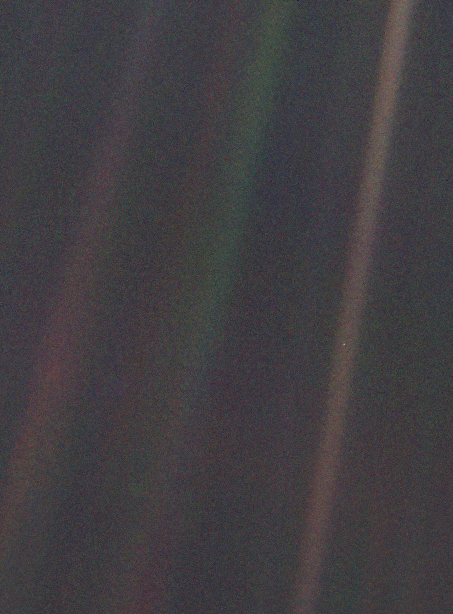
Pale_Blue_Dot.png


And it became the title and inspiration for one of Carl Sagan's most famous writings.

http://www.planetary.org/explore/space-topics/earth/pale-blue-dot.html

Dr. Carl Sagan said:
It has been said that astronomy is a humbling and character-building experience. There is perhaps no better demonstration of the folly of human conceits than this distant image of our tiny world. To me, it underscores our responsibility to deal more kindly with one another, and to preserve and cherish the pale blue dot, the only home we've ever known.

If this is not a religious/spiritual image, I do not know what is.
 
25 years ago today, a classic image of our planet was taken by Voyager 1 from a distance of 6 billion (you read that correctly - billion) km as it raced out of our solar system. On the right side, barely visible, you can make out a tiny, blue speck. That's earth.
If this is not a religious/spiritual image, I do not know what is.
Whether the image illicits thoughts of the `Original Artist' for you, or just how much all there may be to ALL, it certainly is worth a few moments to pause and reflect. It may be a question. It might be an answer. More likely, it is both.

The universe is a big place, perhaps the biggest.- Kurt Vonnegut

All the powers in the universe are already ours. It is we who have put our hands before our eyes and cry that it is dark. - Swami Vivekananda
 
25 years ago today, a classic image of our planet was taken by Voyager 1 from a distance of 6 billion (you read that correctly - billion) km as it raced out of our solar system. On the right side, barely visible, you can make out a tiny, blue speck. That's earth.

Pale_Blue_Dot.png


And it became the title and inspiration for one of Carl Sagan's most famous writings.

http://www.planetary.org/explore/space-topics/earth/pale-blue-dot.html


If this is not a religious/spiritual image, I do not know what is.

It is a religious/spiritual image. What's more, we are it! :)
 
Fixed yer typo. Well, that's my take on it anyway.
Well, Mendalla, you show me exactly where to draw the line between individual end environment, and I'll agree.:)

If, as I feel and speculate, IT is in an ultimate stae of nonduality, inseparability or synthesis, then we are IT. If, on the other hand, we assume that our analyses of IT are absolutely true, then we are only a very small part of it.

I think we are IT, and we are only a very small part of IT, depending on whether we contemplate the universe analytically or experience IT as an inseparable whole. I do both, and both are true for me, but the latter is the greater and ultimate Truth.
 
Last edited:
But it's not a dot in the sky. It's the Earth, Jae. This is not looking up at the sky, but looking back from the sky. It's the only home anyone alive today will ever know (I'm not too optimistic about the Mars colonization thing). I think there's tremendous significance in seeing how tiny our Earth is from this distance. No one would even be able to tell it was inhabited from this distance (visually, there are other non-visual clues they could pick up on). But we know because we live on it.
 
But it's not a dot in the sky. It's the Earth, Jae. This is not looking up at the sky, but looking back from the sky. It's the only home anyone alive today will ever know (I'm not too optimistic about the Mars colonization thing). I think there's tremendous significance in seeing how tiny our Earth is from this distance. No one would even be able to tell it was inhabited from this distance (visually, there are other non-visual clues they could pick up on). But we know because we live on it.
Yes - it's the Earth - the orb upon which we live. The Earth is a beautiful place - with many wonders to behold. There are also other orbs.
 
True enough but they are not as significant to us as a species. We f**k up that "dot" and we are history. Other life may exist on other orbs (in fact, I'd say it's highly probable) but that means nothing to us at this point since we have no way of knowing for sure or communicating if we did know for sure. So that's blue dot is it. Once it is gone, we are gone and, for all we know, so is intelligent life in the universe (though not likely).
 
And, this does point up one thing about symbols - they are quite subjective. I (and Hermann, and Carl Sagan) attach great meaning to this one. Jae likely attaches significance to symbols (the cross?) that I do not find significant or highly meaningful.
 
And, this does point up one thing about symbols - they are quite subjective. I (and Hermann, and Carl Sagan) attach great meaning to this one. Jae likely attaches significance to symbols (the cross?) that I do not find significant or highly meaningful.

yes, at the same time that we're insignificant, we are quite significant and powerful

one can fit in judaism metaphors in there as well, the whole be fruitful & multiply & being stewards of earth -- we are the only species that has the ability to significantly affect our environment...without us, all life on Earth will completely die out, naturally...without us, there can be no attempts at justice, mercy, goodness*...no reruns of Blossom I mean C'MON!

i heard the other day a way one person deals with the whole 'omg, existential angst of being insignificant at the sheer size of reality...' when you ride in a plane, high up, you can see the land below you...people are super tiny or not seen at all...buildings are small...all of our works meld into the background...yet this person isn't intimidated or feeling angsty (well, stay away from the fish, m'kay?)...they now have a wider view of reality, up in the sky...that they, at the end of their journey, go back down into, the human world...

no matter your symbol set that you cherish and use

we are human beings living with other human beings in a human being world and that's pretty cool

* a world without moo-cows, gregorian chants, corn, internet & rocket richard would be a sad world...
 
Last edited:
True enough but they are not as significant to us as a species. We f**k up that "dot" and we are history. Other life may exist on other orbs (in fact, I'd say it's highly probable) but that means nothing to us at this point since we have no way of knowing for sure or communicating if we did know for sure. So that's blue dot is it. Once it is gone, we are gone and, for all we know, so is intelligent life in the universe (though not likely).

Yes - I guess what you say here is true. The thing with me - though - is that I believe humanity and this Earth will be around for quite a long while.
 
And, this does point up one thing about symbols - they are quite subjective. I (and Hermann, and Carl Sagan) attach great meaning to this one. Jae likely attaches significance to symbols (the cross?) that I do not find significant or highly meaningful.

What's significant to me is what I believe Jesus did for humanity. Less so the tangible means by which he did it.
 
Yes - I guess what you say here is true. The thing with me - though - is that I believe humanity and this Earth will be around for quite a long while.

Oh, the Earth will be. Another 4 billion years or so on our warranty even by scientific reckoning.

Humanity? Geologic history shows mass extinction events generally include the dominant species. We are currently in the middle of a mass extinction that we started. Do the math. The difference between us and T Rex is that we are conscious of the danger and can do something about it.

However, if we do collapse and die as a species, that will not be the end of life on Earth, not by a long shot. We saw a 96% loss in marine species and a 70% loss in land-dwelling species in the largest mass extinction event in history (the end of the Permian period) and the world still bounced back in 10 million years or so. There will likely still be life on this pale blue dot long after we are gone.

In fact, latest genetic and archaeological evidence has led to the hypothesis that just prior to modern humans (ie. us, not Neanderthals or others) beginning the migration that spread us throughout the globe, we nearly became extinct. And now look at us.

And that is one of my sources of hope: life is hard to get rid of once it exists and it comes back.
 
And, Jae, I know you're a young Earther so none of that is probably meaningful to you but it's my take on our place in geologic history in a nutshell.
 
As far as we know, this pale blue dot of ours is the only place in the universe where the universe has become consciously aware of itself. Ever human brain is a sense organ, governing the individual organism to which it is attached. But, above and beyond that, each individual brain and organism is also a cosmic sense organ experiencing the universe uniquely, and the universe is experiencing itself uniquely in and through it.

And, if the universe is self-creative--as it appears to be--and the self-creative universe is regarded as God, then every one of us experiences God uniquely, and God is experiencing ITself uniquely in and through every one of us. And everyone and everything is also inseparably united within this eternally self-creative singularity called God.
 
Oh, the Earth will be. Another 4 billion years or so on our warranty even by scientific reckoning.

Humanity? Geologic history shows mass extinction events generally include the dominant species. We are currently in the middle of a mass extinction that we started. Do the math. The difference between us and T Rex is that we are conscious of the danger and can do something about it.

However, if we do collapse and die as a species, that will not be the end of life on Earth, not by a long shot. We saw a 96% loss in marine species and a 70% loss in land-dwelling species in the largest mass extinction event in history (the end of the Permian period) and the world still bounced back in 10 million years or so. There will likely still be life on this pale blue dot long after we are gone.

In fact, latest genetic and archaeological evidence has led to the hypothesis that just prior to modern humans (ie. us, not Neanderthals or others) beginning the migration that spread us throughout the globe, we nearly became extinct. And now look at us.

And that is one of my sources of hope: life is hard to get rid of once it exists and it comes back.

From what I've read, some estimates are that at one point the entire human species may have dwindled to as few as 600 individuals before bouncing back.

As you noted, the advantage humans may have over probably any other species that has ever existed is our ability not only to adapt but even to manipulate nature and the environment. Although we may have used that ability to put ourselves at risk, it isn't inconceivable that we could use it to put things right as well.
 
From what I've read, some estimates are that at one point the entire human species may have dwindled to as few as 600 individuals before bouncing back.

As you noted, the advantage humans may have over probably any other species that has ever existed is our ability not only to adapt but even to manipulate nature and the environment. Although we may have used that ability to put ourselves at risk, it isn't inconceivable that we could use it to put things right as well.

Yes, our ability to think logically, conceptually, abstractly and creatively, and to apply our thoughts to our practical reality, is the ultimate survival tool.
 
Back
Top