Bible Study Thread: Luke

Welcome to Wondercafe2!

A community where we discuss, share, and have some fun together. Join today and become a part of it!

Status
Not open for further replies.
Interesting to note how Mark and Matthew explicitly state that Jesus was baptized by John. Luke introduces John, describes his message and ministry, then his arrest, THEN Luke speaks of Jesus' baptism, with no explicit mention of John. Is there a growing rift between followers of Jesus and followers of the Baptist at this point? Why does Luke tell the story this way?

I noticed that, too. Curious, eh?
 
Thoughts on Luke 3:19-20...

John couldn't continue his work long without interference. With frankness, he didn't hesitate about rebuking Herod, Galilee's tetrarch, for his union with Herodias, his niece and his half-brother Philip's wife. And John's rebuke included all Herod's shame.

And so Herod imprisoned John. The later developments Dr. Luke doesn't relate.

☆ Though the treatment given to pastors won't reach this climax today, the enmity toward their truth and their testimony's abroad today. Many a shameful person's trying to stifle his conscience's voice by violence against missionaries. ☆
 
Thoughts on Luke 3:21-22...

Jesus himself came to be the companion of shameful people that were seeking shame's erasure through Baptism.

Through his baptism, Jesus was inaugurated into his office. For after it, the heaven above him was opened. And God the Spirit came down upon Jesus. The event witnessed of God to Jesus' Sonship, as God the Father cried, "You're my Son. In you I'm pleased."

It was a manifestation intended for Jesus' strengthening at his ministry's beginning. The assurance which he received at his baptism gave him the courage to meet all the trials which must needs fall to his lot as humanity's Vicar.
 
Thoughts on Luke 3:23-38...

Jesus' legal genealogical table's given by Matthew, 1:1-17, who establishes a sequence back to David.

Jesus' natural geneological table's given by Dr. Luke here. It's through Mary.

The names of such men appear as were born of women under a cloud. There were shameful people among Jesus' forefathers, and he was numbered with the shameful even by virtue of his descent.

In comparing this list with the OT accounts, it should be remembered that son and son-in-law are used indiscriminately.

Of interest's that Dr. Luke continues Jesus' genealogy beyond David to Adam, and thus to God. Dr. Luke thereby emphasizes Jesus' Gospel's universality.

Scripture tells us that Jesus' true man, descended with us from one blood, and that he's the Savior promised to the OT fathers, Abraham's seed, Judah's Shiloh, David's son.
 
Interesting to note how Mark and Matthew explicitly state that Jesus was baptized by John. Luke introduces John, describes his message and ministry, then his arrest, THEN Luke speaks of Jesus' baptism, with no explicit mention of John. Is there a growing rift between followers of Jesus and followers of the Baptist at this point? Why does Luke tell the story this way?
Like you and @Mendalla I noticed this in my reading of the chapter.

In Luke's gospel it is only our assumption that the baptism of Jesus was conducted by John.

Luke has John's message being quite consistent with the later teachings of Jesus. I thought his use of the term "brood of vipers" was interesting.
 
paradox3 ----Your Quote -----The Holy Spirit has entered the narrative again and I wonder how we are to understand it descending in bodily form like a dove.

The Dove is mentioned in the Old Testament -----unsafe posting from Genesis

Genesis 8:6-12 (GW)
6 After 40 more days Noah opened the window he had made in the ship 7 and sent out a raven. It kept flying back and forth until the water on the land had dried up. 8 Next, he sent out a dove to see if the water was gone from the surface of the ground. 9 The dove couldn’t find a place to land because the water was still all over the earth. So it came back to Noah in the ship. He reached out and brought the dove back into the ship. 10 He waited seven more days and again sent the dove out of the ship. 11 The dove came to him in the evening, and in its beak was a freshly plucked olive leaf. Then Noah knew that the water was gone from the earth. 12 He waited seven more days and sent out the dove again, but it never came back to him.


unsafe posting here from ---read all for yourselves
Dove Definition and Meaning - Bible Dictionary

Doves and turtle-doves were the only birds that could be offered in sacrifice, as they were clean according to the Mosaic law

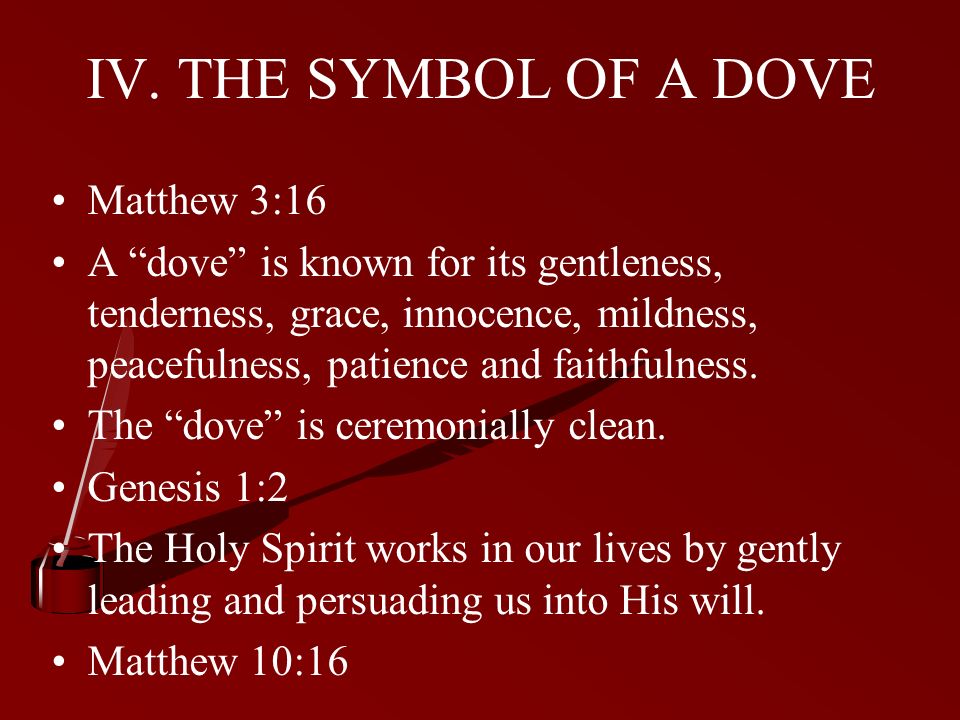
The dove was the harbinger of peace to Noah ( Genesis 8:8 Genesis 8:10 ). It is often mentioned as the emblem of purity ( Psalms 68:13 ). It is a symbol of the Holy Spirit ( Genesis 1:2 ; Matthew 3:16 ; Mark 1:10 ; Luke 3:22 ; John 1:32 ); also of tender and devoted affection (Cant 1:15 ; 2:14 ).

David in his distress wished that he had the wings of a dove, that he might fly away and be at rest ( Psalms 55:6-8 ). There is a species of dove found at Damascus "whose feathers, all except the wings, are literally as yellow as gold" ( 68:13 ).


unsafe says
----So we see the Dove spiritually is associated with Peace and Purity and is used to signify the Holy Spirit ------the Holy Spirit is unseen so using the Dove as a metaphor for the Holy Spirit fits very nicely as it is a symbol of peace --purity of tenderness and devoted affection ---all that describes God -----

So when the Dove was sent out by Noah and it came back with an olive branch it was a sign for Noah that the waters had subsided and peace was on the Horizon -----there was Peace again with God and MAN ------

So when the Dove came upon Jesus it signified that Jesus was fully equipped graced with all he needed to start His Ministry and be effective -----

IV.+THE+SYMBOL+OF+A+DOVE+Matthew+3%3A16.jpg
 
In comparing this list with the OT accounts, it should be remembered that son and son-in-law are used indiscriminately.
Really? If this is the case, (not disputing it, it's just that I have never encountered this idea before) it provides a different lens for viewing the genealogies in both Matthew and Luke.

This is a tidbit I will remember from our WC2 bible study.
 
In comparing this list with the OT accounts, it should be remembered that son and son-in-law are used indiscriminately.

I've never heard this either. Where does this information come from?
 
I've never heard this either. Where does this information come from?
Do you think it might be an idea someone dreamed up to reconcile the different genealogies in Matthew and Luke?

The two gospels give us a different number of generations from Jesus to David. The son-in-law hypothesis will not help with this problem.
 
I really can't be certain, alas. This is the first time I've ever heard of this thought.
In my younger days, I used to believe in something called 'verbal plenary inspiration', the idea that God basically dictated the words to scribes, who simply wrote them down. These days, I think if that were the case, God would have been more careful and more precise in what God said.
 
Divine dictation. If you believe a scripture has been divinely dictated, you'd do as Judaism does, by reading the Torah portion in Hebrew, and as Islam does, by reading the Quran in its original Arabic. I've heard it said in Christianity, where it makes no sense, given that we're happy enough to apply the label "The Word of God" willy-nilly to vastly differing translations into English.
 
Reflection: Luke 21 - 38

Luke puts less emphasis on the baptism of Jesus than the first two gospels. By the time it is mentioned, it has already taken place. The Holy Spirit has entered the narrative again and I wonder how we are to understand it descending in bodily form like a dove.

The voice from heaven serves to establish that Jesus is God's beloved son. The genealogy extends back to Adam, son of God. We are starting to see that Jesus has both a divine & a human nature and the stage is set for His ministry.

I read with interest (notes in my study Bible) that this account by Luke represents the entire trinity being present at the time of baptism - Jesus in human form; the voice (presumably) of God from above; the dove as representative of the Holy Spirit. Do the other gospel narratives comment on such presence?
 
@Redbaron and @BetteTheRed

Years ago, we used to say "The Word of the Lord" after reading the bible in church. The congregation responded, "Thanks be to God".

In my much younger days, the versicle was said only after the OT reading. After the gospel reading, the minister (who always read the gospel) would say "Thanks be to God for this is glorious gospel."

There might have been a time I believed the bible was basically dictated by God but I really don't remember thinking this way. But for many years I considered it to be "inspired" by God . . . not only the words but the canon itself.

This shifted somewhere along the line. I might even need to give Gretta Vosper credit for this. A few years of hearing "This is the witness of God's people" changed up my thinking a bit.

These days I am looking at the bible as the history of a faith tradition incorporating many different faith testimonies.
 
I read with interest (notes in my study Bible) that this account by Luke represents the entire trinity being present at the time of baptism - Jesus in human form; the voice (presumably) of God from above; the dove as representative of the Holy Spirit. Do the other gospel narratives comment on such presence?
Okay, I will go look them up for us.

Matthew? Jesus, voice from heaven, Spirit of God descending like a dove

Mark? Jesus, voice from heaven, Spirit descending like a dove

John also has a baptism story but it is told a little differently. (John 1:29-34)
 
Really? If this is the case, (not disputing it, it's just that I have never encountered this idea before) it provides a different lens for viewing the genealogies in both Matthew and Luke.
This is a tidbit I will remember from our WC2 bible study.

Well, I'm said it only of Dr. Luke's genealogy. In what way do you see it providing a different lens paradox3? I'm pleased if I can contribute something of value.
 
I read with interest (notes in my study Bible) that this account by Luke represents the entire trinity being present at the time of baptism - Jesus in human form; the voice (presumably) of God from above; the dove as representative of the Holy Spirit. Do the other gospel narratives comment on such presence?

Yes, the triune God was present. God the Father's voice came from heaven. God the Son was baptized. God the Spirit descended. What a manifestation. :)
 
@Redbaron and @BetteTheRed

Years ago, we used to say "The Word of the Lord" after reading the bible in church. The congregation responded, "Thanks be to God".

In my much younger days, the versicle was said only after the OT reading. After the gospel reading, the minister (who always read the gospel) would say "Thanks be to God for this is glorious gospel."

There might have been a time I believed the bible was basically dictated by God but I really don't remember thinking this way. But for many years I considered it to be "inspired" by God . . . not only the words but the canon itself.

This shifted somewhere along the line. I might even need to give Gretta Vosper credit for this. A few years of hearing "This is the witness of God's people" changed up my thinking a bit.

These days I am looking at the bible as the history of a faith tradition incorporating many different faith testimonies.

What I basically hold to be true is that God put the information into the heads of the human authors, and then they wrote it down.
 
Jesus in human form; the voice (presumably) of God from above; the dove as representative of the Holy Spirit.
A really interesting point. The voice from heaven is distinct from the Spirit which descends like a dove. And the voice confirms that Jesus is God's Son.

John's account of the baptism includes the writer's testimony that Jesus is both Lamb of God who takes away the sins of the world and the Son of God.
 
Status
Not open for further replies.
Back
Top