The Gospel of Mark

Welcome to Wondercafe2!

A community where we discuss, share, and have some fun together. Join today and become a part of it!

Thoughts on Mark 15:20-47...

The soldiers tired of their sport; their victim bore everything with patience. They therefore took mockery's mantle off him and put his own clothes back on him.

The last act of the greatest drama in the world was about to begin; they led him out from the Praetorium and the city to crucify him.

Now Jesus had been under strain. Gethsemane, the capture, the trial in the high priest's palace, sleeplessness, the scourging, all this now combined to sap his strength.

And so the soldiers pressed into service Simon, a Cyrenian, a belated pilgrim, who was coming in from the country. Mark remarks that this Simon was the father of two men well known to his readers, Alexander and Rufus. So Simon, drafted into service, here had what he later considered the honor of bearing Jesus' cross for him.

Jesus' weakness was increasing. Soldiers carried him the last part of the way, to Golgotha, explained by Mark as meaning a skull's place, because of the hill's shape.

It was the custom to give to the condemned a beverage which would deaden the discernment of reality. But Jesus refused this drink. He wanted to endure his sufferings with consciousness.

The soldiers divested Jesus of his clothes, save for a loin cloth. They put him on the cross and gambled for his clothing. The coat was made a separate stake.

Mark notes the crucifixion's hour, the day's third hour, nine a.m.

Thus did Jesus' crucifixion take place. This world's princes crucified glory's Lord. Christ suffered a criminal's punishment. With his consent he was hanged to cursing's tree.

Pilate had prepared a superscription for Jesus' cross, stating his punishment's cause, in much the same form as it had been given to him by the Jewish authorities: "The Jews' King."

Neither he nor the Jews knew how true the words were, that this man was all humanity's King. But they had rejected him and thereby excluded themselves from the Kingdom's blessings.

Mark notes the precision with which the OT prophecies were being fulfilled in the Passion by noting that two robbers were crucified at the same time, placing Jesus on an the same level as scum.

And now came the procession from Jerusalem to fulfill another prophecy which was spoken concerning the Savior's suffering.

First came the common people, questioning Jesus' sanity in making such statements as his being able to destroy the temple and erect it again in three days. They challenge him to save himself by stepping down from the cross.

Then came the high priests and scribes. The priests act shocked over Jesus' inability to help himself. If they saw him off the cross, then they'd trust in him. This was mockery. They'd refused to trust; and they wouldn't have trusted now.

And, the robbers that were hanging on Jesus' either side, began to insult him, to heap nicknames upon him. It was an orgy of blasphemy that was held there under the cross.

And all the time Jesus was hanging there, suffering and dying for them, for the very ones that were casting the epithets into his face. That's one of history's marvels.

At noon, darkness came upon the earth. It was God's miracle. The universe was suffering with Jesus; the sun lost its light, on account of people murdering their Creator.

These three hours' significance is shown in the Savior's cry at the end of them, "My God, why have you forsaken Me?" This depth of humiliation on Jesus' part's beyond comprehension.

Those three hours cover the mystery of human shame and Jesus' love. He'd been given into hell for the world's shame.

Jesus here felt the divine wrath which has been kindled on account of humanity's shame. He drained the cup of God's curse; he'd suffered hell's damnation.

God's Son was in hell that the elect could go free. He clung to God through it all. God was still his God, to whom he offered obedience and thus conquered hell.

Jesus had cried his last words in Aramaic. Some of those standing near by misunderstood him and told the rest that Jesus had called upon Elijah to help him.

And when Jesus cried out in his thirst and a bystanders ran over with a sponge of vinegar on a reed to give him, he joined in the jeering, whether Elijah would come and help him down from the cross.

But now the end was at hand. Jesus gave a cry, joy's shout, in which he commended his soul into God's keeping, and then he died. It was a severance of soul and body.

But he wasn't overcome by his sufferings. His dying was an act of his own free will. He placed his soul into God's hands. He'd power to lay it down.

And, in dying, he conquered death. He gave himself for his elect, he made a reconciliation for shame. Through death he destroyed the devil, and delivered them who through death were in bondage.

Nature now showed its horror over the deed which had been done on Calvary. While the earth rocked in terror, the veil in the temple was torn into two parts, from top to bottom.

That was a sign that shame had now been taken away. No need of priests to assure the missionaries of God's mercy through animal's blood, since Jesus has gone into heaven and perfected them that are sanctified. The elect may now come to God and depend upon the redemption through him.

The centurion that had charge of the soldiers guarding the cross saw all that happened on and near Calvary. But the greatest impression was made upon him by Jesus' death. Here was a victory, as everyone could see. He and those that were with him heard the accounts of the Jews' Messiah, of the fact that he was to be God's Son and that he should bring salvation to his people. This occurrence opened his eyes; he now realized and confessed, "Truly, this man was God's Son." He had been given faith in Jesus as his Savior.

Further away were women who'd waited on Jesus even in Galilee, and were now his martyrdom's witnesses. Today's female missionaries who serve submissively as they did will also be honored by Jesus.

Friday evening was coming. If something was to be done toward Jesus' burial, it must be done at once.

And here a new missionary is mentioned. His name was Joseph, and his hometown was Ramah. He'd taken no part in the proceedings against Jesus.

This man now came forth for Jesus. He was a missionary, and he hoped for the revelation of God's kingdom before the world. He dared to go in to Pilate and beg for Jesus' body.

After Pilate had received assurance that Jesus had died some time ago, he gave the body to Joseph for burial.

Joseph took down Jesus' body with Nicodemus' aid, wrapped it in linen, and laid it in a grave, in a garden close to Calvary. They then rolled a stone before the sepulchar's door.

And during this time Mary Magdalene and Joses' mother Mary watched where and how Jesus was being laid to rest.

Thus Jesus received an honorable burial. It was given him by missionaries that had formerly been too weak to confess their faith.

In danger's times, the weak became strong and the strong weak. Experienced missionaries have disappointed expectations, while others that were weak in knowledge stood their ground.

And for the elect there's consolation also in the fact that Jesus was laid into a grave. That fact has hallowed their graves. They need fear neither death nor the grave.

As I said to unsafe, thanks for your willingness to delve into this story at this time . . . paradox3
 
Thanks for sharing your thoughts. It is a very difficult story to contemplate or meditate about & I appreciate your willingness to consider it at this time . . . paradox3

Some significant stretch of psyche is required ... but then if thought and such process is denied by laws ... what's law'st ...
 
Just thinking that when I grew up in the United Church, I never attended a Good Friday service. Did we not have them in those days or did I just miss them? Even now, they are not always very well attended.
 
Just thinking that when I grew up in the United Church, I never attended a Good Friday service. Did we not have them in those days or did I just miss them? Even now, they are not always very well attended.

Many folk do not like to attend to the bad Dais and times ... thus mortal conditions! Limited knowledge enSue ...

The edict is overlook, passover, cut corners ... deny needs? Thus iron knees for some ... camels can really present hard knees ... and dueling necks ... Dr Dolittle!

There maybe something to it!
 
Just thinking that when I grew up in the United Church, I never attended a Good Friday service. Did we not have them in those days or did I just miss them? Even now, they are not always very well attended.

I think my family church had them but I don't recall anyone going. Dad maybe on occasion, since he was an elder/chair.
 
Joseph of Arimathea was member of the council that condemned Jesus and he was said to have not agreed with their decicision. He asked for Jesus body to bury....a Pharisee who may or may not have believed in resurrection....and yet he was the one who took care of the burial.
A very interesting part of the story. It actually escaped my notice until I read this post from Waterfall.

I am reminded of the one scribe in an earlier chapter who understood the teaching from Jesus about the Great Commandment.

Maybe the religious authorities of the day were not quite the "bloc" we imagine. But how difficult it must have been for one individual to go against the majority!
 
Here we are, twenty centuries and some removed from the event, still passionately discussing the “Passion” of the man from Nazareth. His Story remains ... relevant to my story and your story and how we should play it out in our own historical context - and the core message of Jesus of Nazareth in the Gospels as far as I can narrow it down for my own understanding (I being neither Christian or Jewish) ...

"What commandment is the first of all?" Jesus was asked. He answered as any good Jew would have answered: "the first is: Hear O Israel the Lord our God, the Lord is One. And you shall love the Lord your God with all your heart, with all your soul and with all your might. The second is this: You shall love your neighbour as yourself. There is no other commandment greater than these."

BBC BBC - The Passion - Articles - Burial series ...
  • Jews recognize in Jesus' answer the Shema, the Jewish declaration of faith, which is recited at every Jewish service, day and night.
  • Jesus is most accurately portrayed not as living his life as a Christian but as a Jew.
  • It can be agreed that Jesus was born a Jew, raised a Jew, taught as a Jew and died a Jew.
  • He was indicted by Pilate as "king of the Jews" and condemned to death as such.
  • Jesus' action in the Temple was a key moment as it marked a turning point in the Temple authorities' view of Jesus.
  • All four Gospels record that Jesus overturned the tables of the money changers, and accused the Temple staff of making what should have been a "house of prayer for all nations" into a "den of thieves".
  • The chief priests were concerned to protect an economy built around the Temple.
  • The Passion depicts Jesus as staging a symbolic destruction, because he believed that destruction was to take place after which the Temple would be radically transformed and the kingdom of God would shortly arrive.
  • The authorities, both religious and secular, took note.
  • Ancient sources like Josephus provide helpful historical detail, The Passion's storyline is put together by combining such material with the Gospels, which themselves, when read carefully, offer important details that illuminate the religious and political context.
  • The action takes place in the period leading up to Passover, a great pilgrim festival when many Galileans, like Jesus and his disciples, will have made pilgrimage to Jerusalem.
  • Pilate, normally stationed by the sea in Caesarea Maritima, reluctantly comes to Jerusalem to keep an eye on the crowds.
  • Jerusalem is full of pilgrims, and the theme of the Passover festival is the liberation of Israel from foreign oppression.
  • On such occasions, it would be surprising if Pilate did not fear a riot, a fear the chief priests would have understood (Mark 14:2).
  • Attempting to understand the historical context of the story is inevitably a sensitive task because of the appalling history of anti-Semitism, which has often been associated with ill-conceived depictions of the Passion narrative in the past.
  • Good history involves understanding the motivations of the characters and avoiding potentially incendiary material.
  • Thus here, Pilate is not cleared of guilt, the crowd does not say "His blood be on us and on our children", Caiaphas is not motivated by evil, and Judas is not demonised.
  • The Passion dramatises the events that Christians celebrate at Easter but understands them in the context of the Judaism that was at the heart of Jesus' thought and practice.
  • Since Passion Plays focus on the suffering, death, and resurrection of Jesus, they have sometimes provided an excuse for anti-Judaism.
  • Typically, the most anti-Jewish sections of a passion play are those relating to the trial and death of Jesus and portraits of Jesus' last days are made more complicated by the differences between the four Gospel accounts. For example, Mark, Matthew, and Luke place Jesus' arrest on the night of the Passover. In John it occurs before Passover. In John, Jesus is brought first to Annas, then to Caiaphas, then to Pilate but in Matthew he is brought only to Caiaphas, and then to Pilate, while in Luke no details of a Jewish trial are given at all, and Jesus is brought before Pilate and Herod Antipas.
  • Such variances indicate the Gospels were written generations after the event and rely on the oral traditions of the earliest Christian communities as their sources. Furthermore, the evangelists were not interested in writing factual, historical accounts of Jesus' last days. They were not historians in the modern sense, but men of faith who were preaching in their communities.
Is it a mistake to treat passion narratives as a straightforward report of what actually occurred? Has His Story been simply retold in the gospels or simply reinterpreted to suit the 'Christian' narrative I wonder?
  • The outcome of the trial is that Jesus is convicted of blasphemy according to Jewish law, and condemned to death as a political trouble-maker by the Roman authorities. There are many odd aspects to this account. The narrators present the Roman authority, Pilate, as being very uneasy about condemning Jesus, and finding it hard to believe that he is guilty of the crime of subversion, or that he constitutes a threat to the Roman administration. This is a strange feature of the presentation because of Pilate's ruthlessness and oppressive behavior and presented a difficult literary and theological problem for the authors of the Gospels as well as for the BBC.
For the Romans, one might say it was all a much simpler matter: had there been an offence against public order that was sufficiently serious to warrant taking punitive action and was there a threat to their political authority?

I digress ... I am finding the Jewish perspective quite compelling ...

Where is the evil in this narrative? @Pinga's thread about evil made me think of this yesterday.
The evil is in the mocking - Jesus was called a bastard (John 8:41), a drunkard (Matthew 11:19), a blasphemer (Matthew 26:65), a devil (Matthew 10:25); and he promised his followers the same: “If they have called the master of the house Beelzebul, how much more will they malign those of his household” (Matthew 10:25). The caricature and mockery of Jesus continues to the cross and on and on and on ... Martin Scorsese portrayed Jesus in The Last Temptation of Christ as wracked with doubt and beset with sexual lust. Andres Serrano was funded by the National Endowment for the Arts to portray Jesus on a cross sunk in a bottle of urine. How should his followers respond? Forgive them for they know not what they do?

But again I digress ... we are only up to "My God, my God, why have you abandoned me?" according to the narratives of Matthew and Mark.
 
How should his followers respond? Forgive them for they know not what they do?

Accept that not everyone worships or lionizes Jesus and that he is just as valid a target as anyone else for a large segment of society? That blasphemy is really only a sin if a believer does it?
 
Accept that not everyone worships or lionizes Jesus and that he is just as valid a target as anyone else for a large segment of society? That blasphemy is really only a sin if a believer does it?

The first part of this sounds right to me.
 
I am interested in understanding these religious authorities better. . . I am wondering if this would assist my understanding of the gospels.

Going to try a new thread about it & see what transpires.
 
the evil is in the mocking ...
Accept that not everyone worships or lionizes Jesus and that he is just as valid a target as anyone else for a large segment of society? That blasphemy is really only a sin if a believer does it?
?
I do not worship Jesus ... as his story goes ... he was tortuously mocked after being found guilty of blasphemy and treason ...
the irony (and the banality) of evil.

Personally I prefer this translation of the events in question as they relate to the Gospel of Mark:

Jesus of Nazareth was executed today on the orders of the Roman State.
Method of execution: Crucifixion.
The charge under Roman law was Treason.
The charge under Herodian law was Blasphemy against the Temple.


The evidence against this anarchist was so strong that authorities of both the Roman State and the Kingdom of Herod concurred with the arrest and execution, and he was subjected to trial by both governments.

In a rare uprising of spontaneous collective justice, a mass of people gathered for Passover called for his execution as well.

The mob affirmed their loyalty to the state, chanting, "We have no king but Caesar."

Friday's execution ended a career as an anti-government agitator with a long history of lawlessness.

Jesus, who is also treasonously called The Christ by his followers, embarked on a public career, with the assistance of his cousin, John, who himself was executed by the state for lack of respect for the office of the king.

Jesus' criminal career included public insults of the king (calling Herod a 'fox' and 'a reed blowing in the wind'), implying that the Roman state was under God and not properly the other way around, harassment of government officials including at least one tax collector and one Sanhedrin member, as well as ordering and/or encouraging them to remit wealth back to the people from whom it was lawfully taxed.

He was also guilty of a series of actions which treasonously called into legitimacy organs of the state such as Herod's Temple. For example, he offered forgiveness and fellowship with God to sinners, violating the temple monopoly of public expiation and forgiveness.

Furthermore, he illegally trespassed on government property and interfered with state-sanctioned money-changing operations which were properly operating with the permission of the appointees of the king at state-approved exchange rates.

He was able for a time to avoid arrest through a tactic of cleverly disguising his anti-government propaganda in the form of coded answers, suggestive but ambiguous analogies, and confusing aphorisms, by which he managed to gather a following without giving clear evidence of his treasonous views.

However, his anti-government propaganda eventually became undeniable: Predicting the destruction of Herod's temple, and even denying its legitimacy, declaring it to be "desolate."

His execution was swift and merciless, and his disciples have been scattered. Authorities are confident that his name will quickly be forgotten, while Rome, the eternal city, will last forever.

The temple built on the power of the Roman state and Herodian kingship will stand forever. Authorities assure the people that the ultimate punishment on which all state power rests, death by execution, is the final word on this short episode in Roman history.

Jesus Of Nazareth, Enemy Of The State, Executed For Treason
 
Last edited:
Summary: Mark 16: 1 - 20

1. The women go to the tomb to anoint the body of Jesus with spices. They find the stone rolled away and a young man, dressed in white, sitting inside the tomb on the right side. He tells them not to be afraid, for Jesus has been risen. They are to go tell His disciples. They leave in fear.

2. The shorter ending of Mark: As instructed, they briefly inform those around Peter. Afterwards Jesus himself sends out, through them, the message of eternal salvation.

3. Jesus appears to Mary Magdalene. Others do not believe this when she tells them.

4. Jesus appears in another form to two disciples. Others do not believe this when they tell them.

5. Jesus appears to the eleven disciples. He rebukes them for their lack of faith and stubbornness for not believing those who said He is risen. He commissions them to go the world & proclaim the good news.

6. Jesus is taken up to heaven to sit at the right hand of God.
 
Here is the good news according to Mark's gospel:

Mark 16:15-18 New Revised Standard Version (NRSV)
15 And he said to them, “Go into all the world and proclaim the good news to the whole creation. 16 The one who believes and is baptized will be saved; but the one who does not believe will be condemned. 17 And these signs will accompany those who believe: by using my name they will cast out demons; they will speak in new tongues; 18 they will pick up snakes in their hands, and if they drink any deadly thing, it will not hurt them; they will lay their hands on the sick, and they will recover.”
 
Reflection: Mark 16: 1 - 20

Wow! We have reached the Easter story.

Matthew's and Mark's gospels provide us with many different details. In the shorter ending to Mark's gospel, there are no post-resurrection appearances of Jesus.

Verses 15 -18 certainly support the idea that only Christians will be offered salvation. The signs are so dramatic it makes me wonder if the gospel writer was speaking metaphorically.
 
Thoughts on Mark 16...

The Sabbath came to a close, immediately after which the shops were opened to take advantage of trade that might happen along before darkness set in.

The three women that had attended Calvary had, on Friday evening, prepared ointments and spices. They now bought spices, to have everything ready against the morrow, for they planned to go out to the grave and anoint Jesus' body. Here's evidence that there was no idea in the missionaries to steal Jesus' body and allege that he'd risen from the dead.

Early did the women leave the city on the next morning, the festival day when the sheaves were offered to God in the temple, that they arrived at the grave at sunrise.

One fact worried them on the way out to the garden: the matter of the stone that had been rolled before the sepulcher. It'd taken two men to put it into place, and there was no chance of their removing it with their strength.

This was the first thing that the women looked for when they saw the tomb. And that the stone was rolled away scared them into thinking of grave robbers. Mary Magdalene brought this story to the city.

While Mary Magdalene was returning to the city, the other Mary and Salome were surprised inside the tomb by what seemed to them a young man clothed in white.

There were many angels present on this morning. But this angel scared the women. Heaven's reflection shone from him, and humans can't endure that without being scared.

But the angel's message, "Be not terrified!" As at Jesus' birth the angel's first words, "Fear not" so the cry went out at this time.

The heart's leaned toward anxiety, feeling its shame. But there's no longer need of fearing, since salvation lies in the empty grave.

The angel speaks of Jesus by the name which had been given him to heap shame upon him. But Jesus' now the name of which he and his are proud. As Jesus he rose from the dead.

Note the speech, "He's risen, he isn't here; see the place where they laid him." All's exultation which struggles for utterance.

And the news must be spread. They should tell his news to the missionaries, and to Peter who had regretted his shame and who would yet feel Jesus' love.

As Jesus had told them, he was now preparing to go, to precede them into Galilee; for there, he wanted to speak to them.

The angel overwhelmed the women. They fled from the tomb; a rapture had taken hold of them. So was their fear that for the present they said nothing to anyone.

After they'd heard that others had also received revelations independent of their testimony, they no longer were quiet about the things they'd heard at the tomb.

Jesus first appeared to Mary Magdalene, one of the women who'd submissively served him.

Mark here summarizes the events of the 40 days after Jesus' resurrection. He enumerates this appearance as one of many. And he identifies Mary Magdalene as the woman out of whom Jesus had driven seven devils.

No sooner had Mary received this evidence of Jesus' resurrection than she hurried to tell it to missionaries at Jerusalem. They refused to believe her. They didn't yet understand Jesus' prophecies concerning his resurrection, as often as he'd tried to impress this fact upon them. This is more evidence against the theory of Jesus' stolen body.

Mark next gives a summary of the afternoon's events.

In a different form Jesus came to two missionaries on their way to Emmaus, dressed differently than he usually was. Most missionaries believed them not.

That was the situation on Easter Day's evening, in spite of an appearance to Peter and the call of those that were now trusting in his resurrection.

Still later, Jesus appeared while missionaries were dining. At that time he chided them for their refusal to believe, when his resurrection's news had been brought to them by sound witnesses.

For these witnesses' accounts should've filled them with faith as to his resurrection. And here they'd been hiding, showing as much trust in Jesus as many of today's missionaries when they face persecution.

Still, he commissioned them. Going out into all the world, they should preach the Gospel to every creature. It's a limitless command.

The Gospel's the only proclamation that belongs in missionaries' pulpits. Other topics are outside of the pale. Every sermon must serve in building Jesus' Church. For the test's faith in that Gospel and in nothing else.

There are so many cults in the world today with schemes for humanity's amelioration. These are worse than trash when it comes to the question, "What must I do to be saved?"

They that believe and are baptized shall be saved. Faith in Jesus through the Gospel and confirming of the benefits of Jesus' salvation through Baptism, that's the only way to become sure of heaven.

The latter fact, salvation through Baptism, is denied by many. Through this faith and in Baptism God gives salvation, assures us of the certainty of heaven's heritage which is reserved for the elect.

But the question's other side can't be passed over in silence, for Jesus' words are impressive. Where there's no faith in Jesus' salvation, damnation's sure to follow.

Jesus gave his missionaries a serious commission. And he tells them signs will accompany their work: In his name to cast out devils, speak with new languages, handle snakes, drink poison without harm and heal people.

These things took place in Church history. And God's power's as mighty today as ever. There are thousands of miracles being done in his name wherever the Gospel's being proclaimed.

A warning concerning false miracles remains timely even today.

Even if it were possible for a person to perform deeds that had miracles' marks, God's promise isn't there.

The Gospel and the Sacraments are the means by which the Church's to carry forward Jesus' work til time's end.
 
Mark 16 verses 15- 16 AMPC

15 And He said to them, Go into all the world and preach and publish openly the good news (the Gospel) to every creature [of the whole ]human race].

16 He who believes [who adheres to and trusts in and relies on the Gospel and Him Whom it sets forth] and is baptized will be saved from the penalty of eternal death]; but he who does not believe [who does not adhere to and trust in and rely on the Gospel and Him Whom it sets forth] will be condemned.

unsafe says ------And Here you have How we are made right with God to have eternal life and here you have what happens to those who do not believe --they will be condemned -----

unsafe says ---Salvation is for now ----there will be no chance for people to be saved after they die -----God has made that clear in His Word ---we die once and then Judgment comes -----So this is no joke here ----God is a God of His Word ---God does not change His Mind ----God has Exalted His Word above His Name Psalm 138-----His word is the Final authority -----

unsafe says -----anywhere you see the Word WILL BE in God's word -----That is a Promise -----and God will never go against what He promises ------When God promises something He will deliver -----

Philippians 4:19(AMPC)
19 And my God will liberally supply fill to the full) your every need according to His riches in glory in Christ Jesus

.
Genesis 17:7-9 (GNT)
Circumcision, the Sign of the Covenant

7 I will keep my promise to you and to your descendants in future generations as an everlasting covenant. I will be your God and the God of your descendants. I will give to you and to your descendants this land in which you are now a foreigner. The whole land of Canaan will belong to your descendants forever, and I will be their God.”

9 God said to Abraham, “You also must agree to keep the covenant with me, both you and your descendants in future generations.

unsafe says --So we see in the Scripture God says He WILL keep His Promise -----God doesn't change His Mind Numbers 23:19


paradox3 ----your quote ---- Verses 15 -18 certainly support the idea that only Christians will be offered salvation. The signs are so dramatic it makes me wonder if the gospel writer was speaking metaphorically.

unsafe says ---No He is Not speaking metaphorically.-----He is speaking His truth and His Promise -----and anyone who thinks He is speaking this scripture as a Metaphor is fooling themselves ----- If you reject Jesus as your Lord and Saviour you reject God period ---Sin is a crime against God and there is a penalty to pay for sin ----the only way to address that is to receive Jesus who paid for our Penalty of death and separation from Him ----God is making that very Clear in His Promise Here -----

16 He who believes [who adheres to and trusts in and relies on the Gospel and Him Whom it sets forth] and is baptized will be saved from the penalty of eternal death]; but he who does not believe [who does not adhere to and trust in and rely on the Gospel and Him Whom it sets forth] will be condemned.

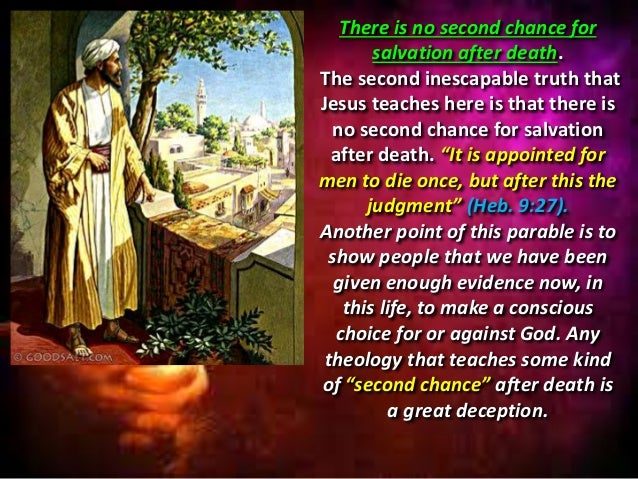
There will be no second chance ----Salvation is for Here and Now ------and anyone who teaches otherwise --Teaches Falsely

Hebrews 9:23-27 (GW)
23 The copies of the things in heaven had to be cleansed by these sacrifices. But the heavenly things themselves had to be cleansed by better sacrifices. 24 Christ didn’t go into a holy place made by human hands. He didn’t go into a model of the real thing. Instead, he went into heaven to appear in God’s presence on our behalf. 25 Every year the chief priest went into the holy place to make a sacrifice with blood that isn’t his own. However, Christ didn’t go into heaven to sacrifice himself again and again. 26 Otherwise, he would have had to suffer many times since the world was created. But now, at the end of the ages, he has appeared once to remove sin by his sacrifice.
27 People die once, and after that they are judged.


08-mission-of-jesus-23-638.jpg
 
Hi @unsafe, thanks for stopping by.

Agreed that there is no support in Mark at all for the idea of a "second chance".

As for the question of metaphor, I was thinking about the handling of snakes and the drinking of deadly things.

The signs that are mentioned in the passage include these two things in addition to casting out demons and speaking in tongues. I find these verses very curious. I note they appear in the longer ending to Mark's gospel.

What do you make of the two different endings?
 
Just had a look at the Revised Common Lectionary.

Mark 16: 1 - 8 is read in Year B.

This takes us to almost the end of the "short" ending of Mark.
Nowhere does the longer ending appear in the cycle of the RCL.

No wonder I was not familiar with the snakes and the drinking of deadly things!
 
paradox3 ------your quote -----
As for the question of metaphor, I was thinking about the handling of snakes and the drinking of deadly things.

The signs that are mentioned in the passage include these two things in addition to casting out demons and speaking in tongues. I find these verses very curious. I note they appear in the longer ending to Mark's gospel.

unsafe says -----as far as the latter part of your quote -----speaking in tongues goes ---this is no joke -----I have that gift and I believe blackbelt1961 also has that gift --so that is real ----and the casting out demons is done today so that is real ----there are 9 gifts of the Spirit listed in scripture

unsafe says ----as far as the Protection goes that is God's Promise -----Protection is included in Salvation -----and is backed by scripture ---going to be posting scripture -----Notice the I am with you ----I will not ===I have given you ---nothing will hurt you ----all promises ----

Isaiah 43 GOD’S WORD Translation (GW)
Bible Gateway passage: Isaiah 43 - GOD’S WORD Translation

43 The Lord created Jacob and formed Israel. Now, this is what the Lord says:

Do not be afraid, because I have reclaimed you.
I have called you by name; you are mine.
2 When you go through the sea, I am with you.
When you go through rivers, they will not sweep you away.
When you walk through fire, you will not be burned,
and the flames will not harm you.


Daniel 3:24-25 (GW)
Bible Gateway passage: Daniel 3 - GOD’S WORD Translation

Shadrach, Meshach, and Abednego Refuse to Worship an Idol


24 Then Nebuchadnezzar was startled. He sprang to his feet. He asked his advisers, “Didn’t we throw three men into the fire?”

“That’s true, Your Majesty,” they answered.

25 The king replied, “But look, I see four men. They’re untied, walking in the middle of the fire, and unharmed. The fourth one looks like a son of the gods.”


Acts 28 (GW)
Paul on the Island of Malta
28 When we were safely on shore, we found out that the island was called Malta. 2 The people who lived on the island were unusually kind to us. They made a fire and welcomed all of us around it because of the rain and the cold.

3 Paul gathered a bundle of brushwood and put it on the fire. The heat forced a poisonous snake out of the brushwood. The snake bit Paul’s hand and wouldn’t let go.

4 When the people who lived on the island saw the snake hanging from his hand, they said to each other, “This man must be a murderer! He may have escaped from the sea, but justice won’t let him live.”

5 Paul shook the snake into the fire and wasn’t harmed. 6 The people were waiting for him to swell up or suddenly drop dead. But after they had waited a long time and saw nothing unusual happen to him, they changed their minds and said he was a god.


Luke 10:19 (GW)
19 I have given you the authority to trample snakes and scorpions and to destroy the enemy’s power. Nothing will hurt you.


paradox3 ---your quote -----As for the question of metaphor, I was thinking about the handling of snakes and the drinking of deadly things.

unsafe says --So again no not a Metaphor ------God's Promise to Protect those who serve His will and purpose and that is in place today -----


unsafe is posting this small bit from Forerunner commentary cause I think it is good advice ------you can read all id you so please

Mark 16:18 (KJV) - Forerunner Commentary

Protection is promised here, not a command to flaunt their God-given authority.
He specifically instructs them "not [to] rejoice in this" because it was not of their doing, not a show of faith. It was God's protection pure and simple.

Hope this answers your question -----:angel:
 
Hope this answers your question -----:angel:
Partly.

How do you explain the two different endings to Mark? I am inclined to think the second one is a later add-on. But I know some people believe it got lost or separated from early manuscripts.
 
Back
Top