Should Unbelievers Say the Apostle's Creed And The Nicene Creed In Their Worship Services ?

Welcome to Wondercafe2!

A community where we discuss, share, and have some fun together. Join today and become a part of it!

unsafe

Well-Known Member
These Creeds are said to profess one's True Faith in ----God the Father ----Jesus Christ and the Holy Spirit ---

The word Creed comes from the Latin Credo, meaning "I believe".

So should Unbelievers take part in Saying the Creeds in their worship place when they reject God ?

The Motive would be showing a Deceptive Practice -----Would it not ?? Saying I Believe when they clearly don't believe-----
 
People doing stuff by rote just to feel part of the ritual is not really deceptive in my books, or is maybe self-deception. I won't say the creeds anymore myself and was not fully in agreement with those two to start with. The UCCan's New Creed fit better with my understanding of things.

How do you respond to those creeds, @unsafe? Neither is really 100% biblical, more a reflection of a period in the church's history. The Nicene in particular is very much a product of the organized, human church that you always seem down on.
 
When the collective, cumulative (accrued) gods (I, you and us) are taken into consideration ... how can a believer accept that nothing will change?

If you believe we are the offspring of the vast mystery ... shouldn't the mystery expect some question from the alternate side ... like absolute desire of the abstract attention? The the mystery gets complex and beyond those that remain simple ... parsimony? The the consideration of projection of strangers into this midst ... myth?
 
People doing stuff by rote just to feel part of the ritual is not really deceptive in my books, or is maybe self-deception.
To expand a bit, IMHO, for saying the creed(s) to be "deceptive" would mean doing it in order to appear Christian, so maybe reciting it as part of joining a church or on a regular basis in a church where they really did not believe but joined for social status or something. If they just happen to be at a service and go with flow, that wouldn't be deceptive in my books.

Also IMHO, people saying creeds they did/do not 100% believe in (many people believe in the broad strokes but not all the details) is fairly common and probably always has been. There was a time where not saying the creeds put you at risk no matter what you actually believed. And doing it to cover your ass is actually a legitimate deception in my books. That's behind us, though, at least in most of the Western world.
 
People doing stuff by rote just to feel part of the ritual is not really deceptive in my books, or is maybe self-deception. I won't say the creeds anymore myself and was not fully in agreement with those two to start with. The UCCan's New Creed fit better with my understanding of things.

How do you respond to those creeds, @unsafe? Neither is really 100% biblical, more a reflection of a period in the church's history. The Nicene in particular is very much a product of the organized, human church that you always seem down on.

Repetition of fixed presentation can refresh questions in some minds while inducing a deadness or rest in others as they tent towards the great rest ...

Imagine reading a myth to a child before sleep ... impressions, dreams!!! The soul is an ode thing ...
 
To expand a bit, IMHO, for saying the creed(s) to be "deceptive" would mean doing it in order to appear Christian, so maybe reciting it as part of joining a church or on a regular basis in a church where they really did not believe but joined for social status or something. If they just happen to be at a service and go with flow, that wouldn't be deceptive in my books.

Also IMHO, people saying creeds they did/do not 100% believe in (many people believe in the broad strokes but not all the details) is fairly common and probably always has been. There was a time where not saying the creeds put you at risk no matter what you actually believed. And doing it to cover your ass is actually a legitimate deception in my books. That's behind us, though, at least in most of the Western world.

Kind of like swearing an oath of allegiance ...
 
Kind of like swearing an oath of allegiance ...
Yeah, that is kind of how creeds have functioned at times, eh. An oath of allegiance to the church's teachings, too, not necessarily to God or Christ.

In UU'ism, they actually teach a course on building your own creed, treating it as a statement of personal faith rather than a statement of corporate faith.
 
By "Unbelievers" do you mean, as you often use the word, people who do not believe exactly as you? If so then the discussion is pointless. If you mean athiests, I am not sure why they would except to be a polite visitor. If you mean follower of another faith then I again see no reason why they should.

THe use of creeds in public worship is a bit of a minefield, particularly the classic Creeds like Nicene or Apostles (or Athanasian for that matter). Truth is the creeds were often formulated as a way of showing who was in or who was out. In fact it can be argued that many or even most statements of faith written down by various communities are created for that very purpose. WHy do we want to draw lines and cut people out?

I know people who, if a creed is being used in worship will suddenly lose their voice on certain lines (eg "born of the Virgin Mary" in the Apostles Creed) rather thn attest to something they do not take as literal historic truth.
 
How do you respond to those creeds, @unsafe?
I am not a Creed Girl- Myself ----I am a Bible Girl -----But I do say the Creeds if they are presented in the Service I attend --

Apparently form what I have Researched the Creeds are not said much anymore ---but I have attended both the Protestant and Catholic Churches and they still say it ----
 
I am not a Creed Girl- Myself ----I am a Bible Girl -----But I do say the Creeds if they are presented in the Service I attend --

Apparently form what I have Researched the Creeds are not said much anymore ---but I have attended both the Protestant and Catholic Churches and they still say it ----
The Catholics are bigger on it than the Protestants, I think. Not sure about Eastern Orthodox churches. Within Protestant denominations, how often creeds are said and which ones are used depends on the denomination to a great degree. Some, like the UCCan, have even modernized their creeds rather than sticking to older ones.
 
These Creeds are said to profess one's True Faith in ----God the Father ----Jesus Christ and the Holy Spirit ---

The word Creed comes from the Latin Credo, meaning "I believe".

So should Unbelievers take part in Saying the Creeds in their worship place when they reject God ?

The Motive would be showing a Deceptive Practice -----Would it not ?? Saying I Believe when they clearly don't believe-----
True faith, unsafe, is grace's gift. God works through grace's ordinary means, including hearing Scripture, prayers, and CONFESSIONS, to draw people to Himself.

Rather than judging whether every unbeliever's being deceptive, I'd leave their heart's state to God, who alone knows whether they're hardened in unbelief or being drawn toward faith.

The greater question's whether each of us can sincerely say the creeds before God
 
I say that God is like the wind ... one wayward and one alternate ... that defines updrafts/downdrafts and generation of flashing lights ...

Again stories have a way of beating around fixations that are due for growth in the understanding of why this is in nature ... while soul is unnatural ... and defined by some as supernatural as up there ...

The passions can certainly drive away knowledge, intellect, psyche, wisdom and Sophia in integral form beyond the passions ... rathe hypnotic in some expressions as people are stunned when seeing an fresher virtue (truth)!
 
By "Unbelievers" do you mean, as you often use the word, people who do not believe exactly as you?
No I mean Unbelievers there GordW ----

Maybe this Definition doesn't Fit what you believe unbelievers are -there GordW--so if you have a Different Definition ---of what an Unbeliever is in your world --------Please Feel Free to Post it ------- :angel:

Bible Hub
Lexical Summary
apistos: Unbelieving, faithless, unfaithful ,that believeth not

properly, not faithful because unpersuaded, i.e. not convinced (persuaded by God).

571 (ápistos) describes someone who rejects or refuses God's inbirthings of faith (note the root, faith, 4102 /pístis).

Central Idea

Strong’s Greek 571 characterizes persons or attitudes refusing to place trust in the living God and His revealed word.

Its presence in narrative, didactic, and apocalyptic passages underscores that unbelief is not merely an intellectual position but a moral and spiritual posture that affects worship, relationships, and eternal destiny.


I say ------You will like this GordW as it comes from Jewish Background
Old Testament Background and Jewish Context


Although the specific Greek term appears only in the New Testament, the concept echoes the Hebrew portrayal of “stubborn” or “hard-hearted” Israel (for example Numbers 14:11; Psalm 78:22).

First-century Judaism viewed covenant loyalty as inseparable from faith in God’s promises; failure to believe was counted as covenant breach and invited discipline.

5. Spiritual blindness: “The god of this age has blinded the minds of unbelievers” (2 Corinthians 4:4). Unbelief is attributed to satanic deception,
 
Rather than judging whether every unbeliever's being deceptive, I'd leave their heart's state to God, who alone knows whether they're hardened in unbelief or being drawn toward faith.
But wasn't Judging ---simpling asking the question ----If one doesn't Have Saving Faith in Jesus Christ ---it is right for them to say the Creeds isn;t that being Deceptive ??-----------what motive do they have in saying it ------that is not Judging them in my view -----it is simply asking them -----
 
I know people who, if a creed is being used in worship will suddenly lose their voice on certain lines (eg "born of the Virgin Mary" in the Apostles Creed) rather thn attest to something they do not take as literal historic truth.
Guilty as charged, especially in my later Christian days when I was dumping a lot of faith baggage and shifting to a rather different faith position. The joke in UU'ism is that people do that singing hymns they disagree with.
 
WHy do we want to draw lines and cut people out?
GordW ------Jesus did just that with the Pharisees ---they were suppose to Be Godly People and Jesus called them out ----calling them Children of the devil ----called them vipers ----defiled on the inside ----Called them False Prophets -----

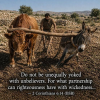
And Gave warnings for Believers being united with Unbelievers ------

Jesus separated believers from Unbelievers in His word -----But you don't follow His Word --you follow your own word ------

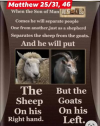
The Parable of the Sheep and Goats tells you that ------Separating the Righteous from the Unrighteous -----

1794339235384.png


You should talk to God and ask Him ----about your Quote here---He might just answer you ------

WHy do we want to draw lines and cut people out?


1794339294510.png
 
I think Jesus and the Pharisees isn't really about belief, though. In fact, historically Jesus and the Pharisees shared some beliefs (e.g. in the Day of Judgement). It's more about the Pharisees setting themselves up, along with other temple elites, as spiritual leaders when they were no more qualified to do so (in his eyes) than anyone else given their hypocrisy and abuse of power. He was calling them out for that as much as for actual beliefs.

And that quote is from Paul, not God, and open to a lot of interpretation given that. He (or his followers since some of the letters may not be by him) is often at the root of Christian exclusivity claims.
Paul, Mendalla, was explaining what Christ's life, death and RESURRECTION mean.

Personally, I find comfort in seeing Paul's letters as a testimony to God's grace. A man who once persecuted Christians became someone captivated by Christ's mercy. That story makes me more inclined to listen to what he wrote.

It's healthy to wrestle with Paul's writings. I'd just be cautious about separating Jesus from Paul, because the earliest Christians didn't see that divide
 
Should Unbelievers Say the Apostle's Creed And The Nicene Creed In Their Worship Services ?

What in the actual f*** does this even mean?

How many of my fellow atheists would know either creed if they tripped over them?

What worship services?
 
However the use of creeds as a dividing tool (or faith statements, thinking of an experience with local ministerials) has been to enforce a level of doctrinal uniformity/purity that does not allow for variation in interpretation and understanding. In other words "if you don't agree with all of this you are obviously a heretic and hopelessly lost". For example, the faith statement on IVCF when I was in university that called for adherence to the so called fundamentals of faith (from which Christian fundamentalism took its name) even though those were not (and never have been) tenets held by the entire church. Only the right kind of Christians were supposed to be there (or really in leadership since that was who had to sign the statement) apparently.

The positive use of Creeds or creed-like statement said in community is that they build the community together. The negative side is that they are a way to cast people out.
It's healthy to wrestle with Paul's writings. I'd just be cautious about separating Jesus from Paul, because the earliest Christians didn't see that divide
Or at least if they did we don't have a record of it. AFter all the church has never been a united body, there have always been differences of opinion on pretty much everything from how to understand/interpret/use SCripture to the nature of Christ and what we now call the Trinity.
 
Back
Top