Weird, cool SCIENCE!! stuff

Welcome to Wondercafe2!

A community where we discuss, share, and have some fun together. Join today and become a part of it!

Just as long as you don't forget to water the plant. :p

Actually, that's the problem with "cover the plant" idea. You'd need to expend some of the water collected to keep the plant alive. With the engineering solution you posted, it's taking the water from the air so it's all available for human use.

This one comes to you courtesy of my wife.

Researchers at Berkley and MIT have designed a prototpe water condenser that extracts water from the air using nothing more than solar power. The heart of this technology is a fascinating little molecule called a metal-organic framework or MOF. The MOF absorbs water vapour from the air and the heat of the sunlight drives it toward a condensor plate where it drips into a collector. The prototype used ~1 kg of MOF and operated at 20-30% humidity. It was able to produce 2.8 liters of water in 12 hours.

No moving parts, no electronics. If this can be scaled up and the prodction costs are relatively low it could be a major breakthrough for parts of the world where clean water is not readily available.


Also, some have pointed out that this system is basically the "vaporators" mentioned briefly in Star Wars Ep. IV : A New Hope back in 1977 (a system used on the desert planet Tatooine to generate moisture for the crops) so s-f strikes again. :D
 
Tonight is a big night for us planetary exploration fans. Cassini, which has been studying Saturn for the last few years, is making a daring run into the narrow gap between the planet and its ring system. This will be the closest we have ever been to Saturn so if it succeeds, the pictures could be spectacular. We won't know the outcome until around 3am EDT/midnight PDT. This, sadly, is part of the run up to the end of the mission, with its final act being a plunge into the planet's atmosphere.

https://www.jpl.nasa.gov/news/news.php?release=2017-121&rn=news.xml&rst=6826
 
They said that they didn't want to drop the Cassini into Titan for a final and very close look for fear of contaminating the moon with the space craft.
 
Way to go, Cassini team! The pass went as planned. Closest ever pics of Saturn's atmosphere now rolling in.

They said that they didn't want to drop the Cassini into Titan for a final and very close look for fear of contaminating the moon with the space craft.

Yep. That's why they are dropping it into Saturn itself and not one of the moons.

More from NASA on the plans for the months remaining before the "grand dive":

https://saturn.jpl.nasa.gov/mission/grand-finale/overview/
 
A controversial new find indicates that people may have been I North America as long as 130,000 YBP.

You beat me to it. I saw the following blog from Scientific American (which takes a fairly skeptical stance, BTW) and thought about posting it in this thread.

https://www.scientificamerican.com/...esh-debate-over-first-humans-in-the-americas/

The basic problem is that the evidence is very, very circumstantial. Stones near broken bones that could have been broken by those stones does not mean that they were. Until we have moredefinitive signs of human habitation (i.e. actual human bones or obvious remains like tools that clearly are tools, as opposed to suggestive looking stones), this will likely be in the "cool theory but needs a LOT more evidence" file.

It also does not necessarily mean these 130,000 year old humans were ancestral to anyone living here today. As the article points out, even if they existed, they could have been one of four species based on the time period. And, given the lack of any evidence between this period and the well documented Ice Age migration, odds are that these early arrivals went extinct and the First Nations are still descended from the migration that happened c. 14-15K years ago.

As a cute aside, the s-f speculative history author Harry Turtledove wrote a collection of short stories entitled A Different Flesh, in which the Europeans discover Homo Erectus living in the New World instead of the First Nations (which are Homo Sapiens). Erectus is one of the possible species.
 
Last edited:
Way to go, Cassini team! The pass went as planned. Closest ever pics of Saturn's atmosphere now rolling in.


Yep. That's why they are dropping it into Saturn itself and not one of the moons.

More from NASA on the plans for the months remaining before the "grand dive":

https://saturn.jpl.nasa.gov/mission/grand-finale/overview/
Okay, I have a question and maybe it's a stupid one, but what is taking the pictures of the Cassini falling into the rings of Saturn? Is there another space craft out there?
 
Okay, I have a question and maybe it's a stupid one, but what is taking the pictures of the Cassini falling into the rings of Saturn? Is there another space craft out there?

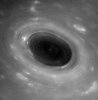
No one is. As @Neo says, those are artistic impressions. The actual pictures taken by Cassini are of Saturn, not itself (no space selfies, alas).

So, things like this:

Cassini.jpg
 
BTW, in case you can't tell, that's a cyclonic storm, ie. a hurricane. The storms on the gas giants are often big enough to swallow our entire planet, with the most famous being Jupiter's renowned Red Spot, which could contain the Earth several times over.
 
No one is. As @Neo says, those are artistic impressions. The actual pictures taken by Cassini are of Saturn, not itself (no space selfies, alas).

So, things like this:

View attachment 837
Which makes sense of course, but during the newscasts I hear the newscasters announce, "this is cassini descending between saturns' rings, as if it is the actual footage. They are not saying, "this is an artists rendition of......"

I remember long ago the first time I realized the planets didn't have the colours that we've been shown and that they were artists renditions.

Just think they should keep it real when reporting.
 
Which makes sense of course, but during the newscasts I hear the newscasters announce, "this is cassini descending between saturns' rings, as if it is the actual footage. They are not saying, "this is an artists rendition of......"

I remember long ago the first time I realized the planets didn't have the colours that we've been shown and that they were artists renditions.

Just think they should keep it real when reporting.

Yeah, artistic impressions tend to exaggerate the colours, though the gas giants' natural colours are quite spectacular to start with (e.g. the aforementioned Red Spot).

In my pre-teen and teen years, I actually had Saturn and four of its moons covering one wall of my bedroom. It was a mosaic of images taken by the Voyager missions turned into a wallpaper mural. I could lie in bed and pretend I was in orbit around the planet.:cool:
 
Looks like my bathtub drain.;)

Oddly, so do hurricanes here. Though, unlike bathtub drains, hurricanes are subject to Coriolis Force so all spin in the same direction (some claim bathtub drains are subject to this as well, but they are actually too small for it to significant).
 
BTW, in case you can't tell, that's a cyclonic storm, ie. a hurricane. The storms on the gas giants are often big enough to swallow our entire planet, with the most famous being Jupiter's renowned Red Spot, which could contain the Earth several times over.

In day's of aulde a whirling dervish ... they can reciprocate down under ... northern people wouldn't believe it until observant ... some are absolute about unseen's ...
 
One of the most important tools in cancer research has been reproducible cell lines. One of the most famous, HeLa (for Henrietta Lacks, the woman from whom it was taken) has become a problem on a number of fronts, some social (the cells were taken from a Black woman in 1951 without her knowledge or consent), some scientific (HeLa cells have contaminated other cell lines).

Oprah Winfrey has produced a movie about HeLa for HBO and Quirks and Quarks is doing a story on it tomorrow.

http://www.cbc.ca/radio/quirks/plas...-to-the-tune-of-billions-of-dollars-1.4086937

Why am I calling attention to this? Well, besides it being an important and interesting story about the process, rather than the product, of science, my wife has just had a paper published in a prestigious cancer journal examining research papers affected by HeLa contamination of a cell line called KB and one of her co-authors, Dr. Christopher Korch, was interviewed by Bob MacDonald for this story.
 
Back
Top